Online shopping is gradually moving beyond search boxes, product listings and manual comparisons. AI assistants can now help consumers research products, evaluate alternatives and, through supported integrations, complete purchases on their behalf.
This emerging model is known as agentic commerce. It changes how customers interact with businesses and how products are discovered.
For marketers, the challenge is to prepare for a buying journey in which AI agents may influence purchasing decisions before a customer even visits a company’s website.
What Is Agentic Commerce?
Agentic commerce refers to buying and selling activities performed or assisted by AI agents acting on behalf of consumers or businesses. Unlike conventional chatbots, which primarily provide information, AI agents can take action by interacting with external platforms and services.
Consider someone looking for a laptop under $900 for video editing. Instead of visiting several online stores, the customer could ask an AI assistant to find suitable models, compare specifications, check prices and shortlist the best options.
With the right integrations and purchasing permissions, the agent may also complete the transaction. The customer sets the requirements, while the AI handles much of the work.
Why Businesses Should Pay Attention
AI-assisted shopping is gaining traction, although fully autonomous purchasing is still developing.
A study published by IBM and National Retail Federation in January 2026, surveyed more than 18,000 consumers across 23 countries. Its findings offer a useful indication of how AI is entering the shopping process:
- 41% of consumers use AI assistants to research products
- 33% use them to look for customer reviews
- 31% use them to search for deals
The research further found that 52% of consumers were comfortable sharing their data, while 83% reported overlapping concerns around privacy, misuse and unwanted marketing.
Together, these findings point to growing interest in AI-assisted shopping, but also highlight the importance of trust and data protection as businesses explore more automated purchasing experiences.
Alongside these changing consumer habits, major technology companies are developing the infrastructure needed to support agentic commerce. Google’s Universal Commerce Protocol, OpenAI’s Agentic Commerce Protocol and Shopify’s investments in AI-powered shopping are examples of this shift.
Businesses that depend entirely on conventional search traffic and manually operated online stores may eventually find themselves competing in a different environment.
How Agentic Commerce Will Change Digital Marketing
The impact on digital marketing goes beyond another channel for generating website traffic. AI agents may influence which brands customers consider, which products make it to their shortlist and where purchasing decisions are made.
This introduces several changes to the way businesses approach marketing.
1. Product visibility will become more dependent on relevance
Traditional SEO often focuses on ranking for keywords with commercial intent. But an AI assistant may evaluate products against a complete set of customer requirements rather than simply returning pages that target a particular search phrase.
For example, someone looking for a laptop may specify a budget, preferred screen size, processor requirements and intended use. The AI evaluates available products against those conditions. A brand that clearly communicates its product’s capabilities has a better chance of being considered than one relying on vague promotional descriptions.
This does not make keyword research less useful. It means marketers will need to pay greater attention to the actual information behind their product and service offerings.
2. Brand positioning will influence AI recommendations
When customers ask an AI assistant to recommend a product, they may receive a shortlist rather than a conventional list of search results. This means brands will need to communicate clearly what sets their products apart and why they are suitable for particular needs.
For instance, a company selling professional cameras may want to be recognized for low-light performance, while another may compete on affordability and ease of use.
Clear positioning helps customers understand these differences and gives AI systems more specific information when evaluating products.
3. Customer trust will become a competitive factor
AI recommendations may draw on product information, customer feedback and other available references. A brand with questionable reviews, inconsistent claims or unresolved customer complaints could struggle to establish confidence.
This makes reputation management more closely connected to acquisition strategy. Businesses will need to pay attention to what customers and credible third-party sources say about their products, not just what appears on their own websites.
4. Advertising will have to adapt
Paid search and social advertising are built around established models of audience targeting, bidding and placement.
AI-assisted shopping introduces another environment in which brands may compete for visibility. Sponsored product placements and commercial recommendations could become important advertising opportunities, depending on how individual platforms develop their offerings.
McKinsey’s analysis of agentic advertising discusses how advertising could evolve as AI systems become more involved in product selection and purchasing.
Marketers will need to understand how paid placements work within these platforms, particularly how sponsored recommendations are identified and presented to consumers.
5. Marketing performance will need a broader measurement approach
Website traffic and keyword rankings will continue to be useful, but they may not explain the full influence of AI on purchasing decisions.
A customer might discover a brand through an AI assistant, research it further and eventually visit its website directly. Conventional analytics may record that final visit as direct traffic. Marketing teams will therefore need to pay greater attention to AI referrals, assisted conversions and the contribution of different discovery channels.
How Businesses Can Prepare for Agentic Commerce
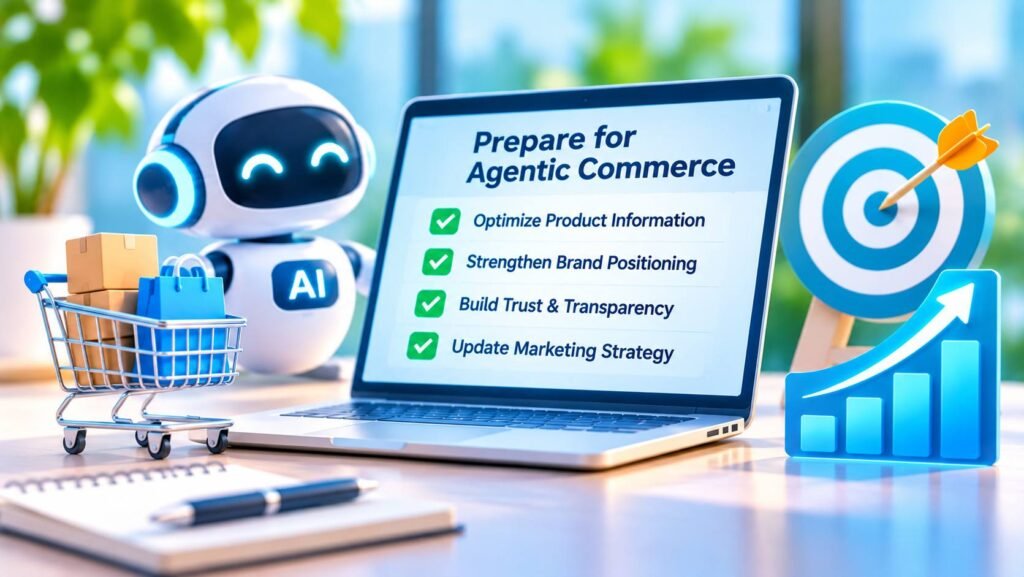
While the previous section explains how marketing strategies may change, preparation involves making actual business systems compatible with this emerging environment.
Businesses do not need to build their own AI agents immediately. They should start by addressing the technical and operational requirements that allow external AI systems to understand and interact with their offerings.
1. Improve product data quality
An AI agent needs factual information to evaluate a product. Generic descriptions such as “premium quality with excellent performance” provide very little practical information.
A headphone listing, for instance, should specify battery life, Bluetooth version, microphone quality, noise cancellation and device compatibility.
Businesses should review their catalogues for:
- Accurate product names, brands and model numbers
- Complete technical specifications and product variants
- Current pricing and stock availability
- Shipping, warranty and return conditions
Larger retailers can consider a Product Information Management (PIM) system to maintain consistent catalogue information across different sales channels.
2. Implement structured data and product feeds
Structured data helps search engines interpret information on webpages. Relevant Product and Offer markup can communicate product details such as price, availability and other attributes.
Google’s merchant listing structured data documentation explains how e-commerce websites can implement this markup.
Product feeds serve a different but related purpose. They provide platforms with structured catalogue information that can be updated as prices, stock and product details change.
OpenAI’s product feed specifications explain how merchants can supply catalogue information for supported ChatGPT shopping experiences.
Adding structured data or creating a product feed does not guarantee inclusion in every AI shopping platform. Each service has its own technical and commercial requirements.
3. Review website accessibility and technical infrastructure
AI-powered discovery does not eliminate the need for a technically sound website.
Businesses should check that important pages are crawlable, product information is available as readable text and internal links make relevant content easy to find. Pay attention to robots.txt restrictions, mobile usability, page performance and accurate structured data.
Google’s official guidance on AI features in Search confirms that existing SEO fundamentals remain relevant. It does not require websites to adopt special AI markup or create additional machine-readable files to appear in AI Overviews and AI Mode.
4. Integrate with compatible commerce platforms
For businesses that want to support AI-assisted purchasing, website accessibility and product information alone will not be sufficient.
Their e-commerce platforms must be able to communicate with external services through supported integrations. This may involve connecting inventory systems, product catalogues, order management software and checkout processes.
Businesses should discuss compatibility with their e-commerce providers rather than developing custom integrations without first understanding which AI platforms and protocols they intend to support.
5. Prepare payment and checkout systems
AI-assisted purchasing requires secure payment processing and appropriate transaction authorization.
Businesses should check whether their payment providers and e-commerce platforms support relevant agentic integrations.
Visa’s Trusted Agent Protocol initiative illustrates how the payments industry is addressing agent identity and transaction security.
Merchants must retain control over transaction authorization, fraud detection, cancellations and refunds. Automated access to checkout systems should never be unrestricted.
6. Review privacy and security practices
AI-driven transactions may involve information being exchanged between consumers, merchants, AI platforms and payment providers.
Businesses should review their data collection and sharing practices before introducing these integrations. Customer information should only be accessed when necessary for the requested activity, with appropriate consent and safeguards.
Security policies should also cover automated access, authentication and the handling of customer and payment information.
The Technology Behind Agentic Commerce
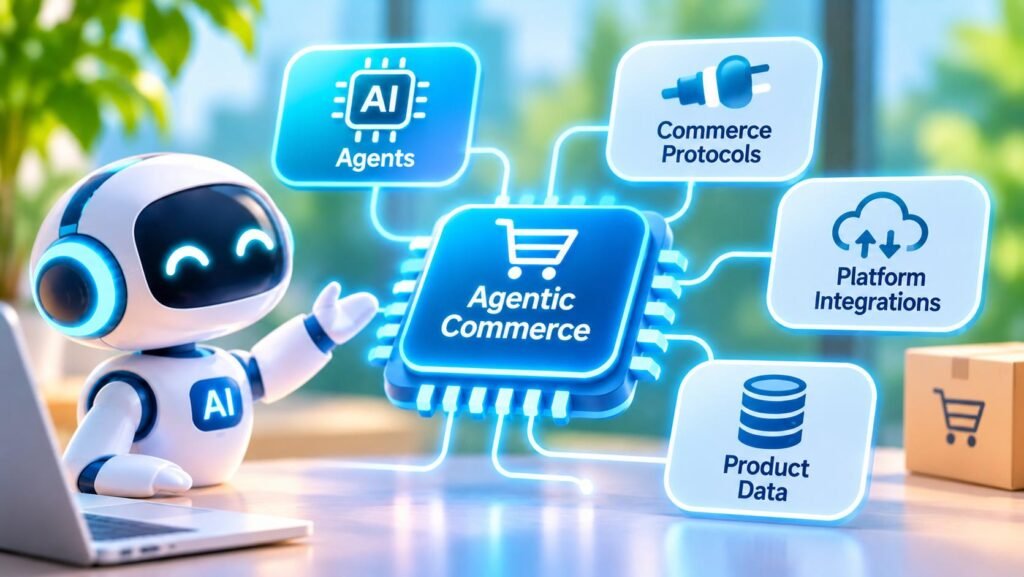
Several protocols are being developed to help AI agents communicate with commerce platforms, applications and payment systems.
Protocol | What it does |
Universal Commerce Protocol (UCP) | Provides a common framework for AI agents, merchants and payment providers to communicate across the commerce journey |
Agentic Commerce Protocol (ACP) | Connects merchants with ChatGPT shopping through structured product information and supported checkout integrations |
Model Context Protocol (MCP) | Allows AI applications to connect with external tools and data sources |
Agent2Agent (A2A) | Enables communication between different AI agents |
Agent Payments Protocol (AP2) | Provides a framework for authorized agent-initiated payments |
Google’s UCP announcement and technical overview explain how an open commerce standard can connect different participants in the shopping ecosystem.
Similarly, OpenAI’s Agentic Commerce Protocol documentation describes how merchants can make catalogue information available to ChatGPT and support relevant commerce interactions.
These protocols address different technical requirements and are not interchangeable. Businesses do not need to implement all of them, but should consider platforms that support reliable integrations and data exchange for their use case.
Challenges Businesses Should Consider
Agentic commerce offers opportunities, but there are practical concerns that could slow adoption.
Consumer trust: Many customers may be comfortable using AI for research but still prefer to approve purchases themselves. Giving an agent permission to spend money requires a higher level of confidence.
Data accuracy: Incorrect product specifications, outdated prices or unavailable inventory can lead to unsuitable recommendations and failed transactions.
Platform dependency: Businesses relying heavily on a single AI platform may become vulnerable to changes in its policies, commercial arrangements or technical requirements.
Security: Automated transactions introduce additional fraud and authorization risks. Merchants will need appropriate controls before allowing external agents to interact with their systems.
Attribution: Identifying exactly how AI influenced a purchase may be difficult, particularly when customers move between AI assistants, search engines and merchant websites.
The pace of adoption will also vary. Product research is easier to delegate than purchasing decisions involving expensive products, financial commitments or sensitive personal information.
What Agentic Commerce Means for the Future of SEO
SEO is not becoming obsolete, but its role is expanding.
Search engine optimization has traditionally focused on helping websites appear in search results. Generative AI has introduced additional ways for consumers to discover information, compare businesses and evaluate products.
Agentic commerce extends this process towards transactions.
For SEO professionals, this means understanding how conventional search visibility connects with AI-powered discovery and product recommendations. Content quality, technical accessibility, structured data and brand credibility remain relevant, but marketers will also need to understand product feeds and commerce integrations. There will be closer coordination between SEO teams, developers and e-commerce managers. Marketing decisions will increasingly involve the quality of information available to AI systems, not just the number of visitors reaching a website.
Final Thoughts
Agentic commerce is developing from AI-assisted product research towards more automated purchasing experiences. The pace of adoption will differ across industries, but businesses can already see where the technology is heading.
The sensible approach is to prepare existing systems rather than rush into every new AI integration. Accurate product information, compatible commerce infrastructure and secure payment systems provide a practical starting point.