Paid advertising used to be a manual craft. Marketers would sit with spreadsheets, adjust bids keyword by keyword, tweak ad copy, watch performance graphs, then repeat the process the next morning. It worked, but it was slow.
Now something very different is happening.
Artificial intelligence is quietly rewriting how pay-per-click campaigns operate, much like it is reshaping discussions around how Google evaluates AI-generated content. Instead of marketers chasing performance signals, machine learning systems are processing millions of data points in the background. They adjust bids, identify audiences, test creative variations, and sometimes even decide which search queries deserve an ad.
The result is what we now call AI-optimized PPC campaigns.
But this shift is not just about automation. It’s about decision quality. AI systems can detect patterns human analysts would never notice, yet they still require strategic direction from marketers who understand the business context.
That balance between human strategy and machine optimization is where modern advertising lives, especially as the search landscape continues evolving through AI-driven experiences.
Let’s understand what AI-optimized PPC campaigns really mean in practice, and how advertisers can actually use them.
Why AI Is Reshaping PPC Advertising
Pay-per-click advertising has always been a data-heavy discipline. Platforms like Google Ads generate enormous amounts of behavioral information: queries, device types, locations, browsing patterns, historical conversions, time-of-day performance.
Humans simply cannot process that volume of signals fast enough. Machine learning systems thrive in exactly that environment.
For example, modern bidding algorithms analyze user intent signals in real time. When someone searches for a keyword, the system evaluates hundreds of contextual variables before deciding whether to bid and how much. These signals include browsing behavior, device type, geographic data, along with predicted conversion probability.
If you explore how automated bidding works in practice, Google explains the mechanics inside its Smart Bidding documentation. The system uses historical campaign data to forecast the likelihood of conversions for each auction.
But Google is not the only platform leaning into automation. Meta’s advertising infrastructure also uses predictive modelling to determine which users are most likely to respond to an ad. Their technical overview of machine learning in advertising delivery explains how large-scale models guide ad distribution.
And the trend extends beyond ad platforms themselves. Research from the Stanford Institute for Human-Centered Artificial Intelligence has highlighted how AI-driven marketing systems increasingly combine behavioral analytics with predictive modelling.
Here’s why this matters. Traditional PPC relied heavily on historical performance data. You looked backward to make decisions.
AI flips the timeline.
Instead of analyzing only past performance, the system predicts future outcomes. It estimates which users are likely to convert before they click. In simple terms, AI advertising systems act less like calculators and more like probability engines.
Where AI Actually Improves PPC Performance
AI in advertising gets talked about a lot, often in vague terms. But in practical campaign management, the impact usually shows up in four areas.
Bid optimization is the first.
Instead of manually setting bids, machine learning systems adjust them based on conversion probability. Advertisers using strategies like target CPA or target ROAS allow algorithms to determine the optimal bid in each auction.
Creative testing is another major area.
Platforms automatically rotate ads, test different headline combinations, and analyze engagement signals. Responsive ad formats make this possible. Google’s responsive search ads combine multiple headlines and descriptions to test thousands of variations.
Audience targeting has also evolved.
AI systems identify behavioral similarities between converters. These insights drive audience expansion and lookalike modelling. Platforms such as LinkedIn Campaign Manager and Amazon Ads use machine learning to refine targeting beyond basic demographics.
Then there’s predictive analysis.
Instead of reviewing what happened last week, AI models estimate future outcomes. Tools such as Adobe Advertising Cloud analyze large performance datasets to forecast campaign results and budget efficiency.
Put together, these capabilities fundamentally change the role of the PPC manager.
Less time is spent adjusting individual settings. More time is spent interpreting signals and guiding strategy.
Structuring PPC Campaigns for AI Optimization
Here’s a practical reality many advertisers discover. Campaign architecture matters. Poorly structured campaigns produce noisy data. And noisy data leads to weak machine learning signals.
Start with conversion tracking – AI bidding systems rely heavily on conversion data. Without it, the algorithm simply guesses. Platforms like Google Tag Manager help marketers implement tracking tags properly, while tools like Hotjar reveal behavioral patterns that explain why users convert or abandon
Campaign consolidation also helps – Older PPC strategies often involved tightly segmented ad groups with small keyword clusters. That approach can starve machine learning systems of data. Larger ad groups with broader keyword coverage allow algorithms to detect patterns faster
Creative diversity matters as well – AI testing systems require multiple ad variations. Without creative diversity, optimization stalls. Platforms such as Canva help marketers generate multiple visual variations quickly, while copy experimentation tools like Anyword help produce headline variations based on performance predictions.
And then there’s data integration – Advertisers increasingly connect advertising platforms with customer data systems. Integrations using tools such as Zapier or analytics environments like Looker Studio allow deeper analysis across campaigns, conversions, and user behavior.
The takeaway is simple. AI works best when it has room to learn.
Practical Steps to Build AI-Optimized PPC Campaigns
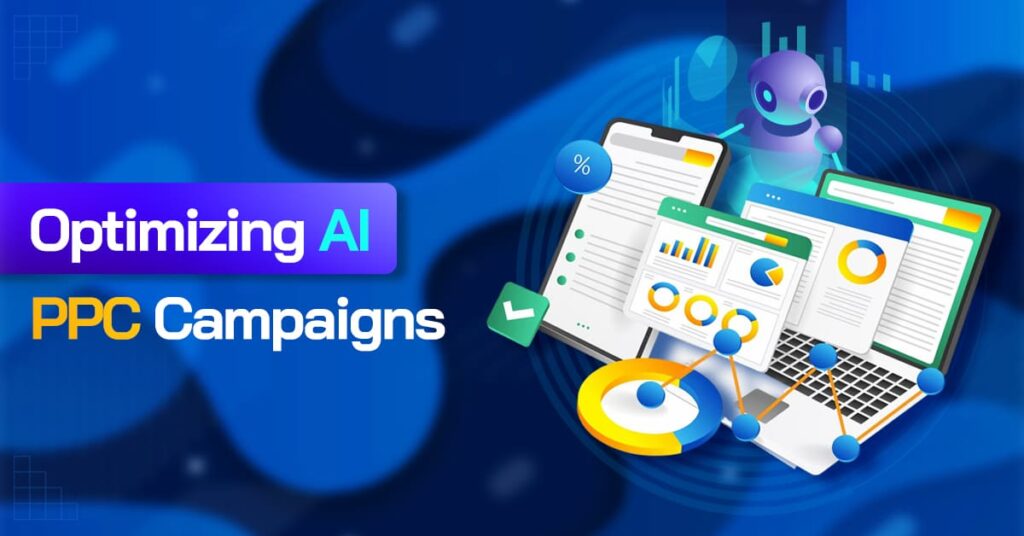
Let’s move from theory to practice. If an advertiser were building an AI-optimized PPC campaign today, the step-wise process would look something like this:
1. Set Up Conversion Tracking First
Before running ads, configure conversion tracking so the algorithm has real data to learn from.
Steps:
- Define the primary conversion you want to track (purchase, lead form, signup, etc.)
- Install a tracking script on your website
- Verify that conversions are being recorded correctly in your analytics dashboard
Tools and platforms that help with event tracking:
These tools allow advertisers to track events such as sign-ups, button clicks, and purchases so AI systems receive accurate feedback.
Without conversion tracking, automated bidding systems cannot learn which clicks actually produce results.
2. Start With a Simple Campaign Structure
Many beginners overcomplicate campaign architecture. AI systems perform better when campaigns have enough data to learn from.
A practical beginner structure could be:
• 1 campaign per product or service category
• 2–3 ad groups inside each campaign
• 10–15 related keywords per ad group
You can identify keywords using research platforms such as:
These tools help discover search demand, keyword variations, and competitive difficulty before launching campaigns.
3. Use Responsive or Dynamic Ad Formats
Modern ad platforms increasingly rely on dynamic ad formats where the system tests multiple combinations of headlines and descriptions.
When creating ads:
• Add 8–10 headline variations
• Write 3–4 description options
• Include keyword variations naturally in the text
Ad testing and creative optimization tools include:
These platforms help generate and test multiple ad variations so machine learning systems can identify high-performing combinations.
4. Use Automated Bidding Strategies
AI-driven bidding strategies allow platforms to adjust bids dynamically based on predicted conversion probability.
Instead of manually setting bids, advertisers can allow the system to optimize toward goals such as:
• maximizing conversions
• maximizing return on ad spend
• achieving a target cost per acquisition
Competitive intelligence tools can help monitor keyword competition and bid environments, such as:
This helps advertisers understand how aggressively competitors are bidding on similar keywords.
5. Upload First-Party Customer Data
AI targeting improves significantly when advertisers provide real customer data.
Examples include:
• existing customer email lists
• past purchasers
• newsletter subscribers
Customer data platforms such as:
allow advertisers to organize CRM data and synchronize audience segments with advertising platforms for remarketing and lookalike targeting.
6. Improve Landing Pages to Strengthen Conversion Signals
AI campaigns perform better when visitors convert after clicking ads.
Focus on simple improvements such as:
• clear call-to-action buttons
• shorter forms
• faster page load time
• mobile-friendly design
User behavior analysis tools can help identify where visitors drop off:
These insights help advertisers refine landing pages so more clicks turn into conversions.
7. Review Performance Weekly
AI-driven campaigns should not be adjusted constantly. Give the system time to learn from performance signals.
A practical weekly review should focus on:
• cost per conversion
• conversion rate
• top-performing search queries
• overall budget pacing
For reporting and dashboards, many advertisers use:
These tools visualize campaign data so marketers can interpret trends without interfering with the algorithm’s learning phase.
Notice something about these steps. They focus less on micromanaging the campaign and more on feeding the algorithm high-quality data. That shift is the entire point.
The Human Role in an AI-Driven PPC World
Here’s a question marketers often ask. If AI manages bidding, targeting, and testing… what exactly do humans do?
Quite a lot, actually. Artificial intelligence is extremely good at pattern recognition, yet it struggles with business context, brand nuance, and long-term strategy. Those areas still belong to people. Campaign strategy requires understanding market positioning, the competitive landscape, and customer psychology. AI cannot invent a brand story or decide which audience segment matters most for long-term growth.
Research published by the Harvard Business Review highlights this human-AI partnership in modern marketing. The most successful teams treat AI as a decision assistant rather than a replacement.
Industry groups such as the Interactive Advertising Bureau have also emphasized the need for strategic oversight when deploying automated advertising systems.
And analytics tools remain critical. Platforms like Looker Studio allow marketers to visualize performance data across campaigns, helping them interpret results generated by AI models.
Here’s the practical reality. AI optimizes tactics. Humans define direction. Machines decide how to reach an audience efficiently. Marketers decide why that audience matters.
Challenges and Risks Marketers Should Watch
AI-driven advertising is powerful, but it is not flawless.
Automated systems depend heavily on data quality. If conversion tracking is inaccurate, the entire optimization model can drift off course. Bad data leads to bad predictions.
Privacy regulations also affect how much behavioral data platforms can use. Laws such as the European Union’s General Data Protection Regulation and California’s Consumer Privacy Act have already reshaped data collection practices in digital advertising.
Another challenge is algorithm transparency. Advertising systems rarely explain exactly how their models make decisions. Researchers at the MIT Technology Review have explored this issue extensively, noting that complex machine learning models can behave like “black boxes.”
And then there’s over-automation. Some marketers rely so heavily on AI systems that they stop monitoring campaigns closely. When performance drops, they struggle to diagnose the problem because the decision logic is hidden inside algorithms.
A balanced approach usually works best.
Use AI for what it does well: pattern detection, optimization, rapid testing. But keep humans responsible for strategic oversight, creative direction, and interpretation of results.
The Future of AI-Powered PPC
AI advertising is still evolving. Large language models are beginning to influence ad copy generation, predictive analytics systems are improving audience modelling, and real-time personalization is becoming more sophisticated.
Platforms like OpenAI’s marketing research initiatives as well as academic studies from institutions such as MIT Sloan School of Management suggest that the next generation of advertising systems will combine predictive modelling with conversational interfaces and automated experimentation.
That means campaigns will likely become even more autonomous. But autonomy does not remove the need for marketers. It simply changes their role.
The modern PPC strategist looks less like a bid manager and more like a systems architect. Someone who designs campaign frameworks, defines objectives, feeds the right data into machine learning systems, and interprets the outcomes.
In simple terms, advertising is moving from manual control toward intelligent collaboration between humans and machines. And the marketers who understand that shift early will have a significant advantage.