Learn the foundations of search engine optimization, including how search engines work, what influences rankings, the main types of SEO and how to start improving your visibility in search.
SEO Explained: The Fundamentals
Search Engine Optimization, or SEO, is the process of improving a website so that it appears prominently in organic (unpaid) search results on platforms like Google and Microsoft Bing.
In practice, this process sits at the intersection of technology, human behaviour and publishing. By bringing these elements together, SEO makes content easier to discover, understand and match with the people searching for it. It is as much about helping search engines understand content as it is about giving users confidence that the information is relevant, reliable and worth their time.
When executed well, SEO brings in highly relevant traffic, improves click-through rates, attracts qualified prospects and enhances brand visibility, ultimately contributing to higher website visits, lead generation and sales growth.
Your Guide to Understanding SEO
This guide takes you through SEO from the ground up, beginning with its main types and how search engines discover, process and rank content. It then moves into the practical side of SEO, from research and content improvement to performance monitoring, while also explaining how SEO differs from and works alongside GEO, SEM and PPC. The aim is not simply to explain individual SEO techniques, but to show how content, technical optimization, authority and user intent work together as part of a broader system.
Whether you are completely new to SEO or looking to strengthen your understanding, you can use this guide as a foundation and return to individual sections whenever you need a deeper explanation.
Types of SEO
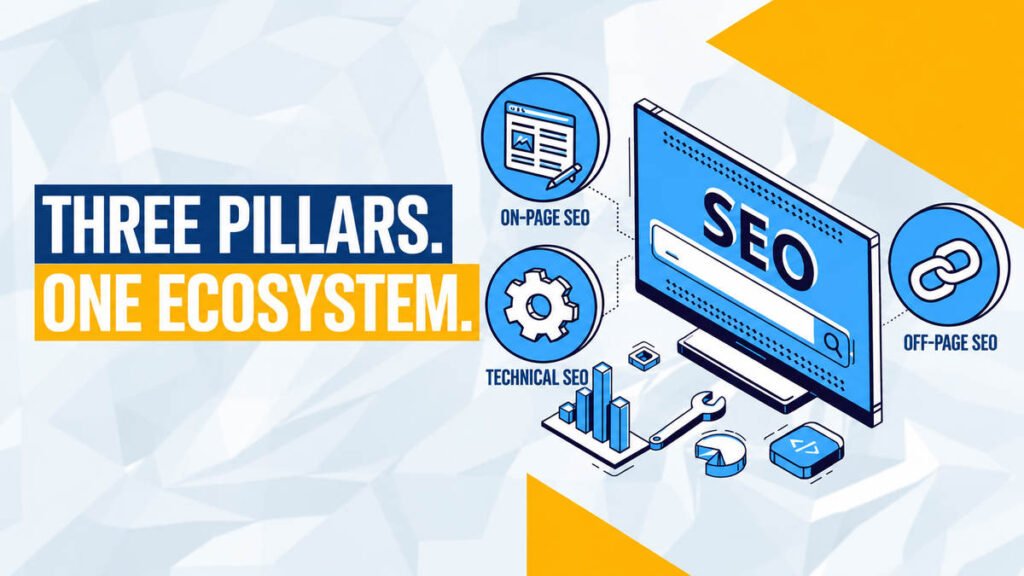
SEO works as a system made up of different parts. However, you’re not running isolated tactics. You’re managing a set of moving components that rely on each other. When one weakens, the whole system feels it.
A simple way to understand this is to think of SEO as being built on three core pillars:
- On-page SEO – this is the content itself; what you publish, how you structure it, and how clearly it answers what someone is searching for
- Technical SEO – this is the foundation; how your site performs, how easily it can be accessed, and whether search engines can process it without friction
- Off-page SEO – this is your reputation; how other websites reference you, talk about you, and whether your brand is trusted beyond your own domain
Now, let’s break each of these down properly.
On-Page SEO (Content Optimization)
On-page SEO is where most people think SEO begins. And in many ways, it does. This is the part you fully control. But it’s also the part most often misunderstood. People reduce it to keywords, headings, and a few tags. That’s not wrong, but it’s incomplete.
On-page SEO is about shaping a page so that it becomes the best possible answer for a specific query, while also being easy for search engines to interpret.
Content Quality and Search Intent
Let’s keep this simple. If someone searches “best running shoes for flat feet,” they don’t want a history of footwear. They want comparisons, real use cases, maybe even a bit of opinion. That’s search intent, and aligning with it is half the job.
A good way to study intent is to use tools like Ahrefs Keywords Explorer to analyze what kind of content ranks. You’ll notice patterns emerging naturally; listicles dominate certain queries, long guides appear for educational topics and product pages show up for transactional searches. These patterns provide useful clues about the kind of content that best aligns with search intent.
But matching intent is only part of the equation. The content still needs to demonstrate that it is useful, credible and informed by genuine knowledge or experience. This is where E-E-A-T principles – Experience, Expertise, Authoritativeness and Trustworthiness, as defined in Google’s Search Quality Rater Guidelines – become particularly relevant.
The four components can be understood as follows:
- Experience means you have actually used, tested or lived what you’re writing about
- Expertise means you demonstrate deep understanding, not surface-level summaries
- Authoritativeness means others in the ecosystem reference or recognize you as a credible source
- Trustworthiness means your content and website feel reliable, transparent and safe
But E-E-A-T is not another framework to simply “add” to your content. It shows through in how you create and present it.
If your page reflects real experience, demonstrates clear expertise and feels trustworthy in how it presents information, you’re naturally aligning with what search engines are trying to reward. That’s why first-hand insights, specific examples and clear authorship increasingly outperform generic summaries, even when both are technically optimized.
Title Tags and Meta Descriptions
These are your first impressions in search results, but they’re not just for clicks because they also help search engines understand your page structure.
- Title tag – keep it clear, include your primary keyword naturally, avoid stuffing
- Meta description – not a ranking factor but affects CTR (click-through rate); write like a human, not a robot
Google sometimes rewrites these anyway, yet well-written ones still give you an edge.
Heading Structure (H1, H2, H3…)
Think of headings as a content map. They break your page into digestible sections for users as well as crawlers, which makes navigation smoother.
Use them logically:
- H1 for the main topic
- H2 for key sections
- H3 for deeper breakdowns
Messy heading structures don’t kill rankings instantly, but they do create confusion over time.
Internal Linking
This is one of the most underrated levers in SEO. Internal links help distribute authority across your site, guide users to related content, and give context to search engines all at once. Wikipedia is a great example; look at how aggressively they interlink pages, it’s not accidental.
Keyword Placement Without Overthinking It
Forget density formulas. Place your keywords where they naturally belong, such as in the title, the first 100 words, headings, and URL, and then just write normally. Over-optimization still happens, and you’ll recognize it when content feels forced or unnatural.
The underlying principle
You can optimize every tag and structure perfectly. But if the content itself is not useful, it won’t sustain performance. And the reverse is also true. Great content that is poorly structured often struggles to get discovered. On-page SEO sits right at that intersection. It ensures your content is both valuable and visible.
Technical SEO (Technical Optimization)
Here’s the part people avoid because it feels complicated, but technical SEO is what allows everything else to work. If your site isn’t crawlable, indexable, secure, and fast, your content won’t perform no matter how good it is.
Crawlability and Indexing
Search engines need to access your pages before they can rank them, which is where Google Search Console comes in.
Key things to check:
- Robots.txt file – ensure you’re not blocking important pages unintentionally
- XML sitemap – confirm all key pages are included and accessible
- Index coverage – verify whether pages are being indexed properly
Sometimes pages don’t get indexed not because they’re bad, but because they’re buried too deep or lack internal links.
Site Speed and Core Web Vitals
Speed isn’t just a nice-to-have anymore. Google introduced Core Web Vitals to measure real user experience, including loading performance, interactivity, and visual stability. You can test your site using PageSpeed Insights, and improvements here can move rankings gradually but meaningfully.
Mobile-Friendliness
Mobile-first indexing means Google primarily uses the mobile version of your site. If your mobile experience is broken, rankings will suffer regardless of how strong your desktop version is. Test it using Google’s Mobile-Friendly Test.
HTTPS Security
This is one area that often gets overlooked in casual SEO discussions, but it matters more than people think. HTTPS ensures that data exchanged between the user and your site is encrypted and secure, which directly impacts trust.
Search engines have treated HTTPS as a ranking signal for years. More importantly, browsers flag non-HTTPS sites as “Not Secure,” which can quietly hurt user confidence and increase bounce rates.
If your site is still on HTTP, moving to HTTPS involves:
- Installing an SSL certificate
- Redirecting all HTTP URLs to HTTPS versions
- Updating internal links and canonical tags
URL Structure
Clean URLs help both users and search engines understand your content. Compare something like example.com/p=123?id=456 with example.com/seo-guide/on-page-seo; the second one wins every time because it’s readable and meaningful.
Structured Data (Schema Markup)
This is where things get interesting. Schema helps search engines understand context better, whether it’s product details, articles, or FAQs. You can explore it on Schema.org, and sometimes this leads to enhanced search listings that improve visibility without changing rankings.
The Reality of Technical SEO
When technical SEO works, nothing feels special. When it fails, everything feels broken.
That’s why experienced SEOs often start here, not because it drives growth directly, but because it removes invisible limits.
The Underlying Idea
Technical SEO doesn’t make your content better. It makes sure your content is able to compete at all. It sets the ceiling.
Off-Page SEO
If technical SEO is about access, off-page SEO is about trust. It answers a different question entirely:
“Why should this site be believed over others?”
And the answer doesn’t come from your website. It comes from the rest of the web.
What Off-Page SEO Actually Represents
Off-page SEO includes all signals that originate outside your site but influence how search engines evaluate your credibility.
People often reduce it to backlinks. That’s understandable. Links remain one of the most important external signals used to evaluate authority and relevance. But off-page SEO is broader. It’s about how your site is perceived externally.
External Validation
Search engines rely on external references because they are harder to manipulate at scale.
If multiple credible sources:
- link to you
- mention you
- reference your content
It creates a pattern. That pattern suggests: “This source is worth paying attention to”. Individually, these signals are small. Together, they shape authority.
Backlinks
Links remain the backbone of off-page SEO. But the way they are evaluated has evolved. It’s no longer about volume. It’s about quality and context.
A strong link usually has:
- relevance to your topic
- placement within meaningful content
- editorial intent
Whereas low-quality links often:
- exist in isolation
- lack context
- appear artificially placed
A handful of strong links can outweigh hundreds of weak ones. That’s why aggressive link building without strategy often fails.
Authority Is Built Through Patterns
Search engines don’t evaluate links one by one. They look at patterns.
Over time, they observe:
- who links to you
- how often you’re mentioned
- in what context your brand appears
If those patterns look natural and consistent, trust builds. If they look manipulated or erratic, trust weakens. This is why off-page SEO takes time and it’s not a one-time activity.
Beyond Links – The Broader Signal Layer
Links are central, but they are not the only signals. Other elements contribute to how your site is perceived. Brand mentions, even without links, reinforce recognition. If your name appears across relevant platforms, it strengthens your presence as an entity.
Reviews and reputation signals matter more in certain contexts, especially for local or product-driven queries. Consistency and sentiment both play a role.
Social platforms sit somewhere in between. They don’t directly transfer ranking value in a traditional sense, but they amplify content. Visibility increases, and that often leads to links and mentions.
Why Off-Page SEO Is Harder
Because control is limited. You can create content whenever you want. You can fix technical issues directly. But you cannot force credible websites to reference you in a meaningful way.
However, you can exert influence:
- through content quality
- through outreach
- through partnerships
- through visibility
The Risk of Oversimplification
A lot of SEO advice still frames off-page SEO as a numbers game. More links, more rankings. That approach doesn’t hold up anymore.
Search engines have become better at identifying:
- unnatural link patterns
- irrelevant sources
- manipulative strategies
So, chasing volume often leads to diminishing returns.
The Real Objective
Off-page SEO is not about acquiring links. It’s about building credibility signals that are difficult to fake.
That usually happens when:
- your content is genuinely useful
- your brand becomes visible in your niche
- your site gets referenced naturally
The Key Takeaway
If on-page SEO is what you say about yourself, and technical SEO is how accessible you are, Off-page SEO is what the rest of the internet believes about you. And in competitive search results, that belief often makes the final difference.
Image SEO: Visibility Beyond Text
Images are often treated as decoration, but they’re also search assets. Optimized images can drive traffic from image search and improve overall page relevance without much extra effort.
File Names and Alt Text
Simple, but often ignored. Instead of IMG_2045.jpg, use something descriptive like red-running-shoes.jpg. Alt text should describe the image naturally; it helps accessibility as well.
You can follow accessibility guidelines from the World Wide Web Consortium.
Image Compression and Formats
Large images slow down your site, which impacts both rankings and user experience. Use tools like TinyPNG to compress images without losing quality. Modern formats like WebP are better for performance than JPG and GIF formats.
Context Around Images
Search engines don’t just look at the image; they analyze the surrounding content as well. An image inside a relevant section carries more weight than one placed randomly.
Image Sitemaps
If images are critical to your content, including them in your XML sitemap improves discoverability and indexing efficiency.
Video SEO: The Overlooked Growth Channel
Video is no longer optional because it’s embedded in search results everywhere. Platforms like YouTube function as search engines on their own, which makes video SEO a separate but connected discipline.
Video Metadata Optimization
Just like web pages, videos need structure. Focus on clear titles, detailed descriptions, and relevant tags that align with search intent. You can learn more from the YouTube Creator Academy.
Thumbnails and Click Behavior
A compelling thumbnail can help attract attention and improve click-through rates. It’s not just design, it’s psychology; contrast, emotion, and clarity all play a role.
Transcripts and Captions
Search engines can interpret video content, but transcripts and captions give them additional textual context to understand and index it more effectively.
Embedding Videos on Your Site
Embedding relevant videos increases time on page, enhances user experience, and adds contextual depth, which can indirectly support rankings over time.
How These Types Work Together
The real overlap begins when work in one part of SEO creates value in another. Better content can earn links and mentions. Those signals can strengthen the authority behind the page, while a sound technical setup ensures search engines can access and process everything properly.
The same applies across the site. Internal links connect relevant pages and distribute authority, while images and videos can extend how that content is understood and discovered.
This is why SEO tends to work cumulatively. Improvements rarely stay confined to one type; their effects often carry into the others.
How Search Engines Work?
To really do SEO well you need to understand what’s happening on the other side.
Most people treat search engines like a black box. You publish a page, wait, and hope it shows up. Sometimes it does and at times it doesn’t. It feels random. It isn’t.
Search engines follow a well-defined process. And once you see how the pieces connect, a lot of SEO decisions start making more sense.
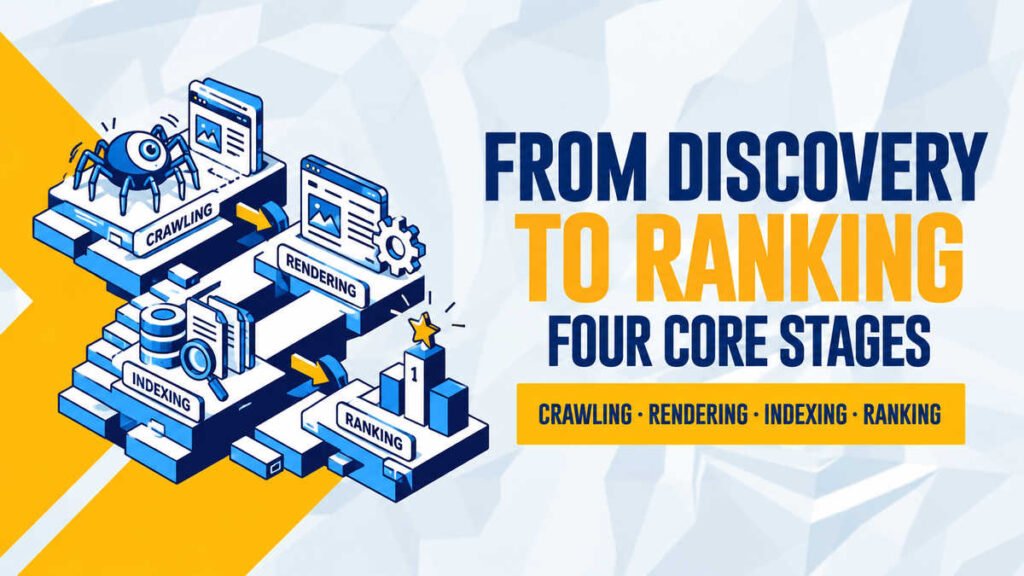
The Big Picture: Four Core Stages
At a high level, search engines like Google and Microsoft Bing operate in four main stages:
- Crawling – discovering content across the web
- Rendering – processing how a page actually looks and behaves
- Indexing – storing and organizing that content
- Ranking – deciding what shows up for a search query
That’s the simplified version. But each of these stages has layers inside it. Think of it like a pipeline. If something breaks early, everything downstream suffers.
Crawling: How Search Engines Discover Pages
Crawling is where everything begins.
Search engines use automated programs called crawlers or spiders. Google’s crawler is known as Googlebot. These bots move across the web, jumping from one page to another through links.
In simple terms, they browse the internet the way you would, just faster and without intent.
How Crawlers Actually Find Content
Crawlers don’t magically know your page exists. They discover it through:
- Links from other pages – internal links and backlinks act as pathways
- XML sitemaps – structured lists of URLs you submit via tools like Google Search Console
- Previously indexed pages – crawlers revisit known URLs to check for updates
If a page has no links pointing to it and isn’t in a sitemap, it’s effectively invisible. It exists, but it’s not discoverable. This happens more often than people realize.
Crawl Budget: The Hidden Constraint
Search engines don’t crawl everything endlessly. They allocate a crawl budget to each site. This is essentially how many pages they’re willing to crawl within a given timeframe.
Factors that influence crawl budget:
- Site authority and trust
- Server performance and response time
- Number of URLs on your site
If your site is slow or filled with low-value pages, crawlers may waste time and miss important content. That’s why technical hygiene matters early.
Rendering: Seeing the Page Like a User
Crawling only fetches the raw HTML. But modern websites are not just HTML. They rely heavily on JavaScript, dynamic content, lazy loading, and client-side rendering.
This is where rendering comes in. Search engines try to process your page the way a browser would. They execute scripts, load resources, and build the final version of the page.
Why Rendering Is Often Overlooked
A page might look perfect to you. But if important content only appears after JavaScript execution, and that execution fails or is delayed, search engines may not see it properly. That leads to partial indexing or, sometimes, complete omission.
You can test how Google sees your page using tools like URL Inspection.
Common Rendering Issues
- Content hidden behind interactions
- Infinite scroll without pagination
- Blocked JavaScript or CSS files
- Slow-loading scripts delaying page completion
At a basic level, if crawling is about reaching the page, rendering is about understanding what’s actually there.
Indexing: Storing and Organizing Information
Once a page is crawled and rendered, the next step is indexing. This is where search engines decide whether to include your page in their database.
And this part is more selective than people think. Not every page gets indexed.
What Happens During Indexing
Search engines analyze your page and extract signals:
- Content meaning and topic
- Keywords and entities
- Structure and hierarchy
- Media elements like images and videos
- Internal and external links
This information is then stored in a massive index. You can think of it as a library, but instead of books, it contains web pages.
Why Some Pages Don’t Get Indexed
Sometimes, pages are crawled but not indexed. Reasons include:
- Thin or low-value content
- Duplicate pages
- Poor internal linking
- Technical directives like noindex tags
- Lack of authority or trust signals
You can check index status inside Google Search Console. And if you see “Crawled – currently not indexed,” it’s usually a quality or prioritization issue, not a technical one.
Ranking: Deciding What Shows Up
This is the part everyone cares about.
Once pages are indexed, search engines evaluate them to determine which ones should appear for a given query, and in what order. This process is called ranking. And it’s not based on a single factor. It’s a combination of hundreds of signals.
How Ranking Actually Works
When a user searches, the engine:
- Interprets the query – what does the user actually mean
- Retrieves relevant pages from the index
- Ranks those pages based on various signals
The goal is simple. Show the most useful, relevant, and trustworthy result. But getting there is complex.
Key Ranking Factors
Instead of listing hundreds, it’s more useful to group them.
Relevance
Does your content match the query? Not just keywords, but intent. A guide won’t rank for a transactional query easily.
Authority
Are other credible sites linking to you? This is where concepts like PageRank come into play.
Content Quality
Depth, clarity, originality, and usefulness. Thin content struggles, even if optimized.
User Experience
Speed, mobile usability, layout stability. Tools like PageSpeed Insights help measure this.
Context and Personalization
Location, device, and search history can influence results slightly.
Algorithms and Constant Change
Search engines don’t rank pages manually. They rely on algorithms and these algorithms evolve constantly.
Updates like Google’s core updates adjust how signals are weighted. Sometimes subtly. Sometimes dramatically. That’s why rankings fluctuate. And that’s also why SEO is never static.
Freshness and Re-Crawling
Search engines don’t crawl your page once and forget it. They revisit pages periodically to check for updates.
Frequency depends on:
- How often your content changes
- Site authority
- Crawl budget
News sites might be crawled every few minutes. Smaller sites, less frequently. Updating content signals relevance. But unnecessary updates don’t help.
How Everything Connects
Here’s where it all comes together.
- If your page isn’t crawled, it won’t be rendered
- If it isn’t rendered properly, it won’t be indexed correctly
- If it isn’t indexed, it can’t rank
- If it doesn’t match intent or lacks authority, it won’t rank well
Each stage depends on the previous one. And SEO, in practice, is about removing friction at every stage.
How Does SEO Work?
SEO is often explained by jumping straight into rankings or algorithms. That’s not wrong, but it misses the point.
What actually drives it is the constant decision-making happening inside search engines. Every time someone searches, they scan their index and choose a handful of pages they believe will best satisfy that query.
What determines those choices are signals, and they don’t come from one place. The most important signals are:
- Content signals – how clearly your page answers a query, how well it is structured, and whether it actually satisfies intent
- Authority signals – links, mentions, and references from other websites that act as endorsements
- Technical signals – whether your site can be crawled, rendered, and understood without friction
- Interaction signals – how users behave when they land on your page
The bigger picture is this; SEO is not about forcing rankings. It is about building enough consistent signals that search engines feel confident showing your page to users. When that confidence builds, visibility follows. When it weakens, rankings slip.
And this is not a one-time effort. It’s a loop. You study what’s happening, decide what to do, make improvements, observe the outcome, and refine again. That loop is where SEO actually lives.
Understanding the Search Landscape

Before anything else, SEO begins with understanding about the search landscape.
You’re trying to figure out what people are searching for, how they phrase those searches, what kind of results are already ranking, and where the gaps or weaknesses exist. This is where most of the leverage sits.
Key areas you typically explore:
- Audience understanding – who your users are, what problems they are trying to solve, and what triggers their searches
- Keyword patterns – the queries people use, their demand, and how competitive they are; tools like Google Keyword Planner or Ahrefs help quantify this
- Competitive landscape – what others are doing well, where they dominate, and where they are vulnerable
- SERP behavior – what type of content ranks, which reveals intent more clearly than any tool
Good understanding reduces guesswork. It tells you what to build, what to avoid, and where you actually have a chance to compete.
Setting Direction and Priorities
Once you have clarity, you need direction, because SEO without direction quickly turns into scattered activity. This stage is about deciding what deserves attention and what doesn’t. Not everything is worth optimizing.
A structured approach usually includes:
- Clear goals – tied to outcomes like leads, sales, or growth, not just rankings
- Realistic timelines – understanding what can move quickly and what requires patience
- Defined KPIs – metrics that reflect meaningful progress
- Resource planning – who is responsible and how work will be executed
- Process and tooling – systems that make SEO repeatable
Direction matters because SEO is a long game. Without it, effort gets spread thin and results remain inconsistent.
Creating and Improving Content
This is where strategy turns into visible output. Pages get created, updated, expanded, or sometimes removed. But this stage is not just about publishing more. It’s about publishing better and more aligned.
Typical actions include:
- Creating new content – building pages around clear gaps identified earlier
- Enhancing existing pages – adding depth, improving clarity, and aligning with intent
- Strengthening internal links – helping search engines and users navigate related topics
- Content pruning – removing outdated, low-performing, or irrelevant pages that dilute quality
This stage often separates average SEO from effective SEO. Anyone can publish content, but fewer people refine it consistently. And sometimes, improvement doesn’t come from adding more words, but from making content sharper and more useful.
Monitoring and Maintenance
Once changes go live, SEO doesn’t pause. Things shift constantly, often without warning. Pages can fall out of the index, site updates can introduce technical issues, and traffic patterns can change overnight. Without monitoring, these issues go unnoticed until they start affecting performance.
You typically keep track of:
- Indexing status – ensuring important pages are still discoverable
- Crawl health – identifying errors that prevent search engines from accessing content
- Site performance – speed, responsiveness, and usability
- Traffic fluctuations – sudden drops or spikes that signal deeper issues
Tools like Google Search Console and Screaming Frog SEO Spider help surface these problems early.
Monitoring is less about constant intervention and more about awareness. It gives you the ability to act before small issues turn into larger ones.
Analysis and Performance Evaluation
Data builds up quickly in SEO. But numbers alone don’t improve anything unless they are interpreted. This stage is about stepping back and asking what the data is actually telling you.
You evaluate performance across:
- Visibility – how often your pages appear in search results
- Traffic – how many users arrive and where they land
- Outcomes – whether those users convert, engage, or take action
- Engagement signals – how users interact with your content once they arrive
Tools like Google Analytics help collect this data, but the real value lies in connecting patterns. If traffic increases but conversions stay flat, intent may be mismatched. If rankings improve after updates, you’ve validated your approach. If engagement drops, content may not be meeting expectations.
Good analysis doesn’t just explain performance. It directs the next move.
SEO Never Stops
SEO is not something you finish. It keeps moving.
Search engines update how they rank content, competitors publish better pages, and user expectations shift. Even your own site evolves, sometimes in ways you don’t notice immediately.
Because of this:
- Content needs to be revisited and refreshed
- Technical health needs to be maintained
- New opportunities need to be identified
Over time, your process improves. Work becomes faster, decisions become clearer, and execution becomes more consistent. Treat SEO as a one-time effort and it fades. Treat it as an ongoing system and it compounds.
Aligning SEO With Real Business Outcomes
This is where SEO either becomes valuable or just busy work.
It’s easy to get caught up in rankings. Watching keywords move up feels like progress. But rankings, by themselves, don’t create impact.
What matters is what those rankings lead to.
- Are users converting into leads or customers
- Is traffic contributing to revenue
- Are you attracting the right kind of audience
A page ranking number one for a low-intent query might bring traffic but no results. On the other hand, a lower-ranking page targeting high-intent queries can drive meaningful business outcomes.
There’s also a structural shift happening in search. Search engines are increasingly answering queries directly through features and AI-generated summaries. In many cases, users get what they need without clicking. That changes the equation.
Now, SEO has to focus more on:
- Intent alignment – targeting queries that lead to action, not just clicks
- Value depth – offering something beyond what’s already summarized in search results
- Brand recall – being recognized even when users don’t immediately click
In other words, SEO is moving closer to business strategy.
How Long Until You See Results?
SEO rarely delivers instant outcomes, and that’s by design. You might see early improvements in a few weeks, especially after fixing technical issues or optimizing existing pages. But meaningful results usually take a few months, and in competitive spaces, significantly longer.
- Early signals – small ranking or traffic movements
- Mid-term gains – noticeable growth in visibility and clicks
- Long-term impact – sustained rankings and consistent traffic
This delay happens because SEO relies on accumulation. Content builds relevance, links build authority, and trust develops over time. But once momentum builds, it tends to sustain itself.
What Metrics Should You Measure?
SEO performance should be evaluated across multiple dimensions, not just one.
You typically measure:
- Visibility metrics – impressions, rankings, and presence across SERP features
- Traffic metrics – clicks, sessions, and landing page performance
- Business outcomes – conversions, revenue, leads, and ROI
- Engagement signals – click-through rates, time on page, repeat visits, and interaction depth
Engagement metrics are particularly useful. They may not always act as direct ranking factors, but they indicate whether your content is satisfying user intent. And increasingly, search engines are getting better at interpreting these patterns at scale.
How Do Search Engine Algorithms Impact SEO?
Before we learn how search engine algorithms impact SEO, we’ll quickly go through what search engine algorithms really are.
A search engine algorithm is a proprietary system that decides which web pages appear in search results, and in what order, when someone types a query. Think of it like a decision engine. Every time a search happens, platforms like Google or Microsoft Bing scan their index and evaluate thousands of pages almost instantly. The algorithm looks at multiple signals, compares those pages, and ranks the ones it believes will best satisfy the user’s intent.
So, if SEO feels inconsistent at times, this is why.
The Algorithm Is Not One Thing
People often talk about “the algorithm” like it’s a single formula. It isn’t. Search engines run multiple sub-systems making multiple calculations at once. Some are rule-based. Others rely on machine learning.
Think of it as layers:
- Core ranking systems that evaluate relevance and authority
- Machine learning systems like RankBrain that interpret queries
- Language models like BERT that understand context
- Spam detection systems filtering manipulation
Each layer affects how your page is judged. And sometimes, small changes in one layer can shift rankings in ways that don’t seem obvious from the outside.
Why Do Search Engines Modify Their Algorithms?
Algorithms don’t change for the sake of change. They evolve because the environment around them keeps shifting.
Improving Search Quality
Search engines survive on user trust. If results feel irrelevant or shallow, users leave. So, updates are constantly pushing toward:
- More accurate answers that directly solve queries
- Content that goes deeper instead of skimming the surface
- Better matching between query intent and results
In simple terms, every update tries to reduce friction between a question and its best answer.
Fighting Manipulation
SEO has always been a game of incentives. And wherever there’s incentive, there’s abuse. People try to game rankings through:
- Artificial backlinks
- Scaled low-quality content
- Keyword manipulation
Algorithms respond by tightening the rules. For example, Google’s Penguin update didn’t just penalize spammy links. It changed how links were valued altogether. Entire strategies became obsolete almost overnight.
And this cycle keeps repeating. Exploit, detect, neutralize.
Adapting to User Behavior
Search behavior doesn’t stay still. People search differently today compared to five years ago:
- More conversational queries
- More mobile-driven searches
- More expectation of instant answers
Updates like BERT helped search engines process natural language better. Suddenly, context mattered as much as keywords. So, algorithm updates are not just defensive. They’re adaptive.
Types of Algorithm Updates: Major, Minor and Core
Not every update shakes the industry. Understanding the difference helps avoid overreaction.
Major Updates
These are targeted and impactful. They usually focus on a specific issue like spam, links, or content quality. Panda and Penguin fall into this category.
When these roll out:
- Entire tactics can stop working
- Specific sites get heavily impacted
- Recovery often requires structural changes
You feel these updates immediately.
Minor Updates
These happen all the time, often quietly. They include small tweaks to ranking signals, UI changes, or adjustments to how certain factors are weighted. Most sites won’t notice them individually. But over time, they compound.
Think of them as constant fine-tuning rather than disruption.
Broad Core Updates
These are the big ones. Google rolls them out several times a year. They don’t target a single issue. Instead, they re-evaluate the entire ranking system.
What makes them tricky:
- There’s no specific “fix”
- Impact is widespread
- Rankings shift based on overall content quality and relevance
If a site drops after a core update, it usually means others are now considered more helpful or relevant. Not necessarily that your site did something wrong.
Major Algorithm Changes That Shaped SEO
Across different types of algorithm updates, some have had a much greater impact on SEO than others. They’ve changed how SEO itself is practised. Some targeted specific problems, while others fundamentally changed how search engines understood and evaluated content. Here are some of the most significant.
Panda
The Google Panda update went after thin, duplicate, and low-value content. Before Panda, scale worked. After Panda, depth started winning. Sites that relied on mass publishing saw sharp declines. Meanwhile, well-researched content gained visibility. It forced a mindset shift that content was no longer just about volume.
Penguin
Google’s Penguin update changed how backlinks were interpreted. It penalized manipulative linking patterns and forced a move toward natural link acquisition. Think of it this way: links stopped being numbers and started being signals of trust.
Hummingbird
With Google Hummingbird, search engines moved beyond keyword matching. They started understanding the intent behind queries.
This pushed SEO toward:
- Topic clusters
- Context-driven writing
- Answer-focused content
It wasn’t a small tweak. It changed how content needed to be structured.
RankBrain
RankBrain introduced machine learning into rankings. It allowed the system to adjust based on user interaction. If users preferred certain results, rankings adapted. This added a behavioral layer to SEO. It wasn’t just about optimizing pages anymore. It was about how users responded to them.
BERT
BERT improved how algorithms interpret language nuance. Small words like “to” or “for” started influencing meaning more clearly. That reduced the effectiveness of rigid keyword targeting and rewarded more natural writing.
Helpful Content System
Google’s Helpful Content updates focus on rewarding content created for people first. This system evaluates whether content:
- Demonstrates real experience
- Provides original insight
- Avoids being written just to rank
This is clearly where things are heading.
How Algorithm Modifications Affect SEO?
This is where everything connects. Algorithm changes don’t just move rankings. They change how SEO is done.
Rankings Become Volatile
After major or core updates, fluctuations are common. Traffic can drop sharply, then stabilize weeks later. Or rise without clear reason. That uncertainty is part of modern SEO.
Strategies Get a Shorter Shelf Life
Tactics age faster now. What worked a few years ago:
- Keyword-heavy pages
- Aggressive link building
- Thin affiliate content
doesn’t hold up anymore. Algorithms shorten the lifecycle of shortcuts.
Quality Threshold Keeps Rising
You can’t get away with average content anymore. Ranking now requires:
- Depth
- Clarity
- Relevance
And often, a bit of originality.
Technical SEO Acts as a Foundation
If your site has crawl or performance issues, it struggles to compete. Problems like slow speed or poor structure don’t always cause penalties. But they quietly limit visibility.
Tools like PageSpeed Insights and Search Console help surface these issues. Think of technical SEO as infrastructure. Without it, everything else weakens.
User Signals Start to Matter More
Behavioral data feeds back into rankings.
If users:
- Click but leave quickly
- Don’t engage
- Return to search
it signals dissatisfaction. And rankings can adjust accordingly.
Intent Alignment Becomes Critical
This is non-negotiable now. Even strong content won’t rank if it doesn’t match what users expect. Algorithms are better at interpreting intent than ever before.
SERPs Evolve Beyond Blue Links
Search results now include snippets, panels, and interactive elements. A large share of searches don’t result in clicks anymore, as highlighted in this zero-click search study. So, SEO expands beyond rankings into visibility strategy.
What to Take From This
If you zoom out, there’s a clear direction. Algorithms are pushing SEO toward real usefulness, clear structure and genuine authority. Shortcuts fade, but sustainable strategies compound. Over time, sites that stay aligned with this direction tend to stabilize, even through updates.
Algorithms don’t just influence SEO. They define its boundaries. Every update reshapes what works and what doesn’t. You can keep reacting to individual changes or you can understand the broader pattern behind them. In practice, the second approach tends to last longer.
What Are SERPs?

SERP stands for Search Engine Results Page. It’s the page a search engine returns after processing a query. Sounds basic, but this page is where the entire game of SEO plays out. Rankings, visibility, clicks, traffic, conversions… all of it lives here.
SERPs typically include a mix of organic results, paid advertisements and features like snippets and knowledge panels.
The Types of Results on a SERP
Not all results are created equal. And they don’t all behave the same way.
Organic Results
These are the classic unpaid listings. They appear because the search engine believes they are the most relevant and authoritative answers to your query. Ranking here depends on hundreds of factors, including content quality, backlinks, relevance, and technical health.
Even within organic results, things have evolved. You’ll see rich snippets, enhanced listings, sometimes even collapsible sections.
Paid Results (Ads)
You’ll usually see these at the top or bottom. Platforms like Google Ads allow businesses to bid on keywords and show ads. These are marked as “Sponsored” or “Ad”, though the distinction is getting subtler. Yet, they affect click behavior a lot.
SERP Features
This is where things get interesting. SERP features are enhanced elements designed to give users faster answers or richer experiences. Some of the major ones include:
- Featured Snippets – quick answers pulled from a webpage and shown at the top; often called “position zero”
- Knowledge Panels – information boxes about entities like people, brands, places
- People Also Ask – expandable questions that branch into more queries
- Image Packs – visual results grouped together
- Video Results – often pulled from YouTube
- Local Packs – maps and business listings, especially for location-based searches
- Top Stories – news-related results, usually from authoritative publishers
Each of these changes how users interact with the page. Sometimes they click, sometimes they don’t need to.
Personalization and Context: Why SERPs Differ for Everyone
Two people can search the same query and see different results. That’s not a bug. It’s intentional.
Search engines personalize SERPs based on factors like:
- Location – search for “restaurants” in Gurgaon versus Mumbai and the results shift completely
- Search history – previous behavior influences future results
- Device – mobile SERPs are structured differently than desktop
- Language and settings
Google explains this in its guide on how search results are personalized. So, when someone says “I rank #1”, the obvious question is: for whom?
Mobile vs Desktop SERPs
This deserves attention because the layout changes quite a few things. Mobile SERPs are tighter – more scroll-based and more dominated by features. Organic listings get pushed down. Ads and SERP features often take up the first screen entirely.
And since Google operates on mobile-first indexing, what your site looks like on mobile directly impacts performance. Their official documentation on mobile-first indexing breaks this down clearly.
How Search Intent Shapes SERPs
SERPs are not static templates. They adapt based on intent. Search engines classify queries broadly into:
- Informational – looking for knowledge
- Navigational – trying to reach a specific site
- Transactional – ready to buy or act
Search for “what is SEO” and you’ll see guides and explanations. Search for “buy iPhone 15” and you’ll see product listings, ads, maybe reviews. Search for “Facebook login” and you’ll likely get the official site right at the top.
The SERP is basically reflecting what the engine thinks you want.
Why SERPs Matter for SEO?
Everything in SEO leads to this page. You can have great content, solid backlinks, perfect technical setup. But if you don’t understand how SERPs are structured for your target queries, you’re guessing.
A few practical implications:
- Ranking alone is not enough – position matters, but so does the shape in which the result appears
- SERP features can steal attention – even if you rank high
- CTR (click-through rate) depends on presentation – title tags, meta descriptions, rich results
- Intent alignment is critical – mismatch it, and you won’t rank or convert
Think of SERPs as the battlefield, not just the scoreboard.
Optimizing for Modern SERPs
You don’t optimize for “Google” in the abstract. You optimize for the actual SERP your users see.
Some approaches that tend to work:
- Structure content for featured snippets – clear answers, concise formatting
- Use structured data – adding schema markup through Schema.org
- Target questions – especially for People Also Ask sections
- Build topical authority – not just single pages, but clusters
- Improve page experience – speed, usability, mobile friendliness
The Future of SERPs
Search is moving towards more direct answers, AI-generated summaries and conversational interfaces. Google AI Overviews and AI Mode are already pushing search further in this direction.
That doesn’t kill SEO. It reshapes it. Content and authority still matter, but the way results are displayed keeps changing.
How Is SEO Different from GEO?
There’s a quiet shift happening in search. Not the kind that comes with loud algorithm updates or ranking volatility charts. This one is more structural. Search is no longer just a list of links – now it’s answers, summaries, conversations, recommendations. And that’s where the difference between SEO and GEO starts to matter.
Most people still treat them as the same thing. They’re not. They overlap, yes. But the intent behind them, the mechanics, even the way success is measured… all of it is drifting apart. Let’s examine this in detail.
But First – What is GEO?
GEO stands for Generative Engine Optimization. It’s a newer discipline, shaped by AI-driven search systems like ChatGPT, Google Gemini, and Perplexity AI. Instead of returning a list of links, these systems generate answers, which changes quite a few things at the backend.
In GEO, you’re not just trying to rank a page. You’re trying to become part of the answer itself. Consider it this way: SEO gets you onto the stage, GEO gets your words into the script.
The Core Difference: Links vs Answers
This is the cleanest way to understand it. SEO is about ranking links while GEO is about influencing generated responses.
In traditional search:
- The user types a query
- The engine retrieves and ranks pages
- The user clicks a result
In generative search:
- The user asks a question
- The AI synthesizes an answer
- Sources may or may not be cited
That last part is important. Visibility is no longer guaranteed by ranking alone. You could be the top-ranking page and still not be included in the AI’s answer.
How Content Is Interpreted
SEO has always relied on structured signals such as keywords, headings, internal links and schema markup to help search engines interpret content more precisely.
GEO works differently. AI models don’t just scan for keywords. They interpret meaning across large datasets, so context matters more than exact phrasing. Instead of asking “Have I optimized this page for the right keywords?”, you start asking “Does this explain the topic clearly and completely for someone who doesn’t already understand it?”
Because generative systems tend to favor:
- Well-structured explanations
- Clear definitions
- Context-rich content
- Balanced viewpoints
This is why you’ll often see them pull from smaller, lower-ranking sites if the content is sharper.
The Role of Authority Changes
In SEO, authority is often visible through backlinks, domain strength, brand recognition. Tools like Ahrefs or SEMrush measure it explicitly.
In GEO, authority becomes more implicit. AI models are trained on vast datasets. They don’t count links in real time. Instead, they rely on patterns learned during training and retrieval systems layered on top.
So, what matters?
- Consistent mentions across trusted sources
- Inclusion in high-quality datasets
- Clear, factual, well-cited information
And yes, traditional authority still helps, but it’s no longer the only gateway.
Clicks vs Presence
SEO has always been click-driven. Rank higher leads to more clicks, which drives traffic. You can track this easily using Google Search Console.
GEO shifts the focus. Sometimes users don’t click at all. They read the generated answer and move on. So, the question becomes: did your content contribute to the answer being shown? This introduces a different kind of visibility, one that’s harder to measure. You might see fewer clicks but higher brand recall, or increased direct searches later.
Change in Query Behaviour
People don’t search the same way inside AI systems. They don’t type short keyword phrases like “best SEO tools 2026.” They ask more natural, layered questions like “What are the best SEO tools for a small agency and why?”
Longer queries bring more context and clearer intent, and AI thrives on that. This means GEO content often needs to:
- Address layered questions
- Provide reasoning, not just answers
- Anticipate follow-up queries
In simple terms, shallow content struggles here.
Feedback Loops Are Slower in GEO
SEO gives you clear signals. Rankings. Impressions. Click-through rates. GEO doesn’t.
You often don’t know when your content was used, how frequently it appears, or what impact it had. So, optimization becomes less reactive. You focus more on quality than immediate metrics.
The Visibility Layer Problem
Here’s something most people miss. In SEO, visibility is explicit. You see rankings, impressions, clicks. It’s measurable. In GEO, visibility is layered.
- The AI might use your content without citing it directly
- It might paraphrase your ideas instead of quoting them
- It may merge multiple sources into a single, unified response
So, attribution becomes blurred. If users don’t click, publishers don’t get traffic. If they don’t get traffic, traditional monetization models like ads, lead funnels, or on-site conversions weaken.
That doesn’t mean there’s no benefit. Visibility turns into influence. Brand recall, trust signals, and repeated exposure inside answers start to matter more than raw clicks. And the sites that treat visibility beyond clicks alone will adapt faster.
Optimization Tactics: Where They Diverge
Let’s get practical.
SEO tactics still look like this
- building high-quality backlinks through outreach and PR
- optimizing page speed using tools like Google PageSpeed Insights
- structuring content for search intent
- fixing crawl issues via Google Search Console
- targeting keywords with tools like Ahrefs
These are still essential. They are not going away.
GEO tactics are evolving
- writing content that answers questions directly and completely
- using clear, structured formats that AI can easily interpret
- building topical authority rather than isolated pages
- ensuring factual accuracy and consistency across content
- creating original insights, not just summaries
Also, content freshness matters differently. AI models may rely on older training data, but many systems combine that with live retrieval. So updated content still has an edge.
SEO and GEO Are Not Competing
GEO doesn’t replace It builds on it. Search engines themselves are blending both. Google’s AI-generated summaries are a good example, part of what they call Search Generative Experience. You can read about it here: Google’s generative AI in Search announcement.
So, your strategy shouldn’t be either-or. It should be layered:
- Use SEO to get indexed, ranked, and discovered
- Use GEO principles to shape how your content is interpreted and reused
The Bottom Line
SEO and GEO share the same foundation, but they’re built for different outcomes. SEO helps you get seen, while GEO helps you get understood.
And increasingly, both are required. If your content is only optimized for rankings, it may still miss the conversation. If it’s only written for AI, it may never get discovered in the first place. So, the real work is in the middle.
How Is SEO Different from SEM and PPC?
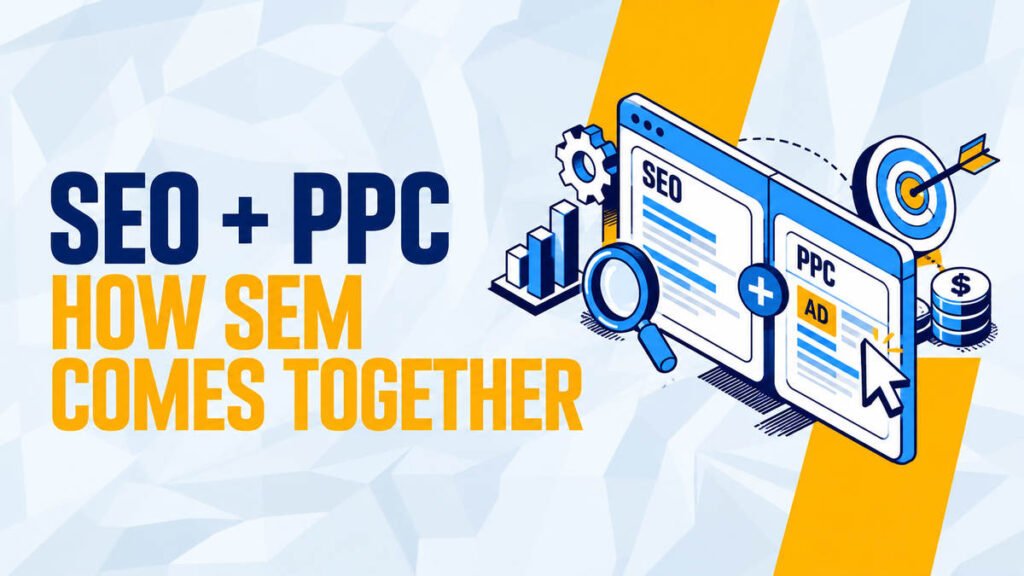
This is where a lot of confusion starts. People use SEO, SEM, and PPC almost interchangeably, especially in casual conversations or even in agency pitches. But they are not the same thing. They overlap, yes. They even support each other, but the mechanics, the intent and the outcomes are different.
If you’re running a business or managing growth, this distinction matters more than it seems. Because where you invest time versus money depends on how clearly you understand this.
Understanding the Relationship First
Before comparing, it helps to place them correctly.
- SEO (Search Engine Optimization) – focuses on earning visibility in organic search results
- PPC (Pay-Per-Click) – focuses on paid visibility where you pay per click
- SEM (Search Engine Marketing) – an umbrella term that includes both SEO and PPC
So structurally: SEM = SEO + PPC
SEO vs SEM
Let’s start with the bigger comparison. SEM includes both organic and paid search strategies. SEO is only the organic side. But that definition is too neat. In practice, the difference shows up in how you approach growth.
How They Operate
- SEO – you earn rankings over time by improving content, technical structure, and authority signals
- SEM – you combine SEO with paid campaigns, usually through platforms like Google Ads to dominate visibility
SEM is not a tactic. It’s a strategy layer. If SEO is like building a reputation slowly, SEM is more like managing both reputation and advertising at the same time.
SEO vs PPC: Where the Gap Becomes Obvious
Now let’s isolate PPC because this is where most confusion actually lies.
1. Cost Structure
- SEO – you don’t pay for clicks. But you invest in content, tools, and time
- PPC – you pay every time someone clicks your ad
With PPC, the meter is always running. With SEO, the cost is upfront and ongoing, but traffic itself is not billed per click.
2. Speed of Results
- SEO – slow build; results can take months
- PPC – immediate visibility; campaigns can go live in hours
If you need traffic tomorrow, SEO won’t help you. PPC will. But the moment you pause PPC, visibility disappears; SEO, once it gains traction, tends to keep working in the background.
3. Position on the SERP
PPC ads usually appear at the top or bottom of the results page and are marked as sponsored. SEO results sit below ads, but users often trust them more.
This difference in perception matters. You can read more about how ads appear in search results in Google’s ad placement guide.
4. Click Behaviour and Trust
This one is subtle. Organic results tend to attract more trust, especially for informational queries. Paid ads can perform extremely well for transactional searches.
Example:
- Searching “what is SEO” – users prefer organic guides
- Searching “buy running shoes online” – ads perform strongly
So it’s not about which is better. It’s about matching intent.
5. Sustainability
- SEO – compounds over time; traffic can continue even if you pause active work
- PPC – stops instantly when budget is paused
The cleanest way to understand this would be; SEO builds assets. PPC rents attention.
A Practical Example
Let’s say you run an online store selling fitness equipment.
With SEO:
- You create guides like “best home gym setup”
- You rank for informational queries
- Traffic builds gradually
- Some of those users convert later
With PPC:
- You bid on “buy treadmill online”
- Your ad shows immediately
- Users click and purchase directly
Same platform, but a completely different approach.
Where SEM Fits Into This
SEM is what happens when you don’t choose one over the other. You use both.
- SEO brings in steady, compounding traffic
- PPC fills gaps, tests keywords, and captures high-intent users
Many mature businesses operate like this. They use PPC to test what converts. Then they build SEO content around those insights.
Tools like Google Keyword Planner are often used in PPC campaigns, but the data feeds directly into SEO strategy as well. This crossover is where things get interesting.
Search Intent: Choosing Between SEO and PPC
The difference between SEO and PPC is not just technical; in fact, it is largely behavioral.
Informational Intent
Users are researching, learning, comparing
SEO dominates here because users want depth
Transactional Intent
Users are ready to act
PPC performs strongly because it captures immediate demand
Navigational Intent
Users are trying to reach a specific brand
Both SEO and PPC can appear, sometimes competing with each other
Understanding this changes how you allocate budget.
Measurement and Tracking Differences
SEO and PPC also differ in how clearly you can measure performance.
SEO Metrics
- Organic traffic
- Keyword rankings
- Impressions and CTR via Google Search Console
- Engagement and conversions
PPC Metrics
- Cost per click (CPC)
- Conversion rate
- Return on ad spend (ROAS)
- Quality Score, explained in detail here: Google Ads Quality Score
PPC gives faster feedback. SEO gives slower but deeper insights.
Control vs Dependency
This one is often overlooked.
- SEO – you influence rankings, but you don’t control them
- PPC – you control when and where ads appear, as long as you pay
SEO depends on algorithms. PPC depends on budget.
Competitive Dynamics
In PPC, competition shows up immediately in your costs. More advertisers bidding on the same keywords push CPC higher, sometimes within hours.
In SEO, competition plays out differently. It doesn’t charge you per click, but it raises the bar. Stronger competitors mean more effort, better content, and more time to break through.
So:
- PPC competition hits instantly – higher bids, tighter margins, faster budget drain
- SEO competition builds pressure gradually – slower progress, longer timelines, deeper investment
Both can become expensive over time; just through completely different mechanisms.
When Should You Use What?
This is where most people expect a simple answer. There isn’t one. But there are patterns.
Use SEO when:
- You’re building long-term visibility
- You want consistent, compounding traffic
- You can invest time and content resources
Use PPC when:
- You need immediate results
- You’re launching a product or campaign
- You want to test demand quickly
Use SEM (both) when:
- You want full coverage across the funnel
- You’re operating in a competitive market
- You care about both short-term revenue and long-term growth
The Overlooked Overlap
Here’s something that shows up in real-world campaigns. SEO and PPC often target the same keywords. And sometimes, businesses run ads even when they rank organically.
Why? Because owning more space on the SERP increases total clicks. It also pushes competitors down. There’s some data around this behaviour in Google’s study on paid and organic search interaction. So, it’s not always a choice between the two. Sometimes it’s about stacking them.
How to Get Started with SEO?
By now you understand what SEO is, how it works and what drives rankings. But knowing the system and actually getting started are two different things. This is the no man’s land most people find themselves on – despite all the information gathering about keywords, rankings, backlinks, technical audits and content optimization. Much of it feels scattered and disconnected, making it difficult to turn into a practical strategy.
Think of SEO like building a house. You don’t start with paint colours, you start with land, design, structure and then utilities. Same principle applies here. An order is required for the process to work.
Start With a Defined Goal
Before you open any SEO tool, ask yourself this: What are you trying to achieve with your website?
Are you –
- generating leads
- selling products
- building authority in a niche
- creating a content-driven business
This is not a philosophical question. It directly shapes how your SEO will work.
If your goal is lead generation, the focus shifts toward high-intent queries, location-based keywords, and pages that convert. Think service pages, landing pages, and clear calls to action (CTAs).
If you want to sell products, the structure changes. You need category pages, product optimization, and content that supports buying decisions. Queries closer to “buy”, “best”, or “price” start to matter more than general awareness.
If the idea is to build authority in a niche, the game pivots to long-term. You publish consistently, go deeper than competitors, and cover topics in clusters. Traffic compounds slowly, but trust builds along with it. The goal here is to build domain credibility.
And if you’re looking to run a content-driven business, your model depends on both scale and depth. You target a mix of informational and commercial queries, optimize for engagement, and often rely on multiple revenue streams like ads, affiliates, or subscriptions.
A simple comparison makes this clearer. A local service business targeting “plumber in New Delhi” will prioritise location pages, reviews, and quick conversions. A content site writing about “how plumbing systems work” will focus on depth, internal linking, and long-term traffic growth.
Figure Out What Your Audience Is Searching For
Next, we move to keywords, but not in a mechanical way. You’re not just collecting phrases but trying to understand audience behaviour. A good starting point is Google Keyword Planner (you can access it inside Google Ads). It gives you search volume and variations.
But numbers alone don’t tell the full story. Search your topic manually and look at:
- what kind of pages are ranking
- how are they structured
- what’s the positioning
For a deeper understanding, tools like Ahrefs Keywords Explorer help you analyse difficulty, variations, and related queries more effectively.
Don’t Start Broad, Choose Your Entry Points Carefully
A common mistake is targeting broad, competitive keywords too early. Things like “SEO tips” or “digital marketing” look attractive, but they’re also unrealistic when you’re starting out. Against conventional wisdom, go narrow.
Focus on long-tail queries with clear intent, specific problems people are trying to solve, and topics where competition is weaker.
For example, instead of “SEO tools”, try “SEO tools for small agencies”. And instead of “weight loss”, try “diet plan for night shift workers”. These smaller entry points help build momentum faster.
Set Up Your Website Properly (Before Publishing Anything)
This is the boring, laborious bit. But skipping is not an option and creates problems later. You don’t need a complex setup. But get the basics right from the start and it will save you heartache later. Ensure you have:
- Clean site structure
- Mobile-friendly design – test using Google’s Mobile-Friendly Test
- Fast loading pages – check with PageSpeed Insights
- HTTPS enabled
Then connect your site to Google Search Console. This becomes your control panel.
Building Your First Set of Content
Next comes publishing where most people tend to rush. What is important to remember is that every page should exist for a reason. Start with a small set of core service or product pages, supporting informational articles, and one or two deeper guides.
When writing, ensure it answers the queries of your audience directly, structure content clearly, include examples where needed, and avoid fluff. Your first articles won’t be perfect. That’s normal. SEO is iterative.
Learn Internal Linking Early
When you publish content, don’t leave pages isolated.
- link related articles together
- guide users from broad topics to specific ones
- use natural anchor text
Internal links help search engines understand relationships. They also improve user flow.
Get Your First Signals of Authority
SEO doesn’t happen in isolation; it needs external validation. Start by sharing content in relevant communities, reach out for feedback, contribute guest posts where relevant, and list your site on basic directories if applicable.
You are not chasing volume here; you are building initial signals.
Track What’s Happening (Even if It’s Slow)
SEO feels slow early on, which is normal. It builds gradually.
Use these:
- Google Analytics – To track organic traffic growth, monitor user engagement rates, and identify which landing pages retain visitors the longest
- Google Search Console – To review the performance data for impression growth, identify rising keyword positions, and ensure pages index successfully
At first, pages get indexed, impressions appear with occasional clicks. Small signals. But important ones. Pay attention to which pages start showing impressions and for what kind of queries. That’s early feedback on whether you are aligned with intent or are slightly off.
But don’t react too quickly – early data is directional, not definitive. Let patterns form before you start changing things.
Improve Before You Expand
Many people keep publishing new content without analysing, revisiting or improving existing pages. This is a rookie mistake. Often, your fastest gains come from refining what you already have.
- update content to match intent
- improve clarity
- add missing depth
- strengthen internal links
Sometimes even one update moves a page significantly.
Understand That SEO Is a System, Not a Checklist
SEO is not a linear process:
- write content
- add keywords
- build links
And voilà, it’s done! No. It’s a system that develops over time. Content, technical setup, and authority all interact. If one part is weak, everything slows down.
Progress usually comes from fixing the constraint, not doing more of everything. Sometimes that’s bettering content, sometimes it’s internal linking, and sometimes it’s just making sure your pages are actually getting indexed.
Common Early Mistakes
Everyone makes mistakes when starting with SEO, and you probably will too. Over-optimizing keywords can make content feel unnatural and forced. Ignoring search intent often leads to creating pages that rank for the wrong audience or fail to convert. Publishing too quickly may increase output, but it usually comes at the cost of quality, clarity and trust. And overlooking technical basics can quietly hurt performance.
Then there’s the temptation to chase shortcuts. Many videos and “quick win” strategies promise fast rankings, and some may even work for a short period, but they rarely hold. SEO has a way of exposing impatience.
A Practical Way to Start
You do not need to master everything on day one. Start small with baby steps, one at a time, and build point by point, layer by layer. SEO may be technical in many aspects, but it still requires that organic, human and intuitive touch.
The important thing in the beginning is not perfection but direction. Some pages will perform better than expected, others may not move at all. You will also notice that different websites gain traction in different ways. Some grow through topical depth, others through strong service pages, niche expertise or consistent updates. There is no fixed formula that works identically for every site or industry. Over time, the scattered pieces start connecting and the overall strategy becomes far more intuitive. That’s enough to begin. The rest builds as you see what works and where the gaps are.