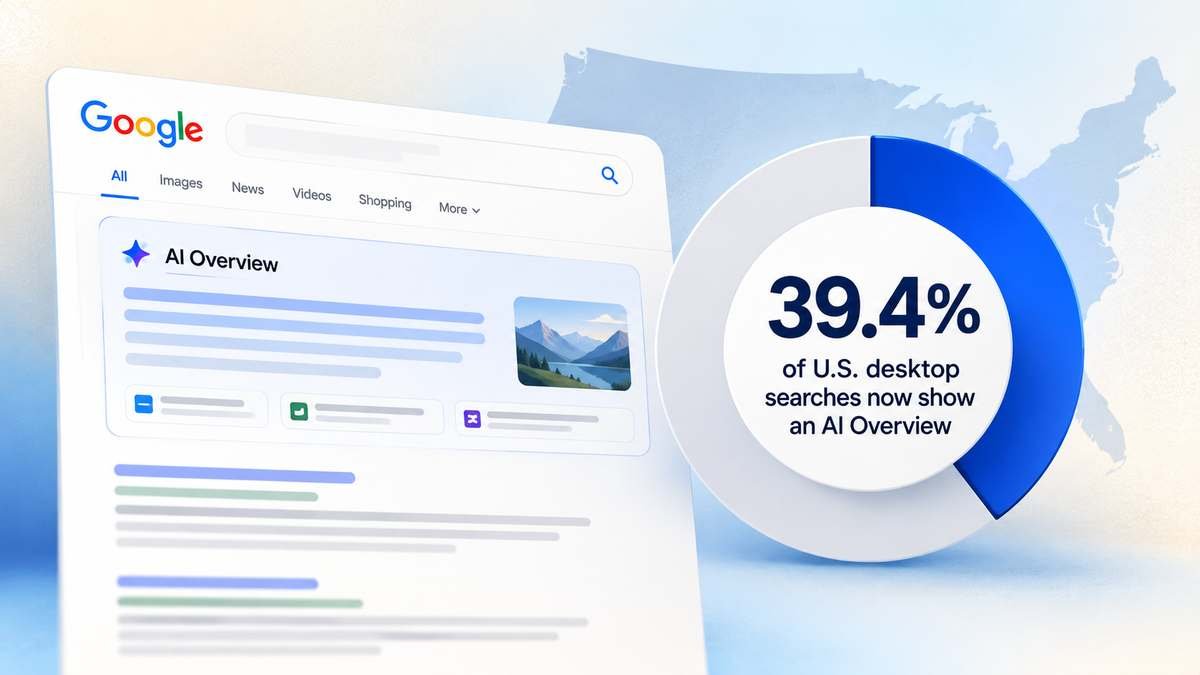
New Comscore data shows that 39.4% of U.S. desktop Google searches included an AI Overview in June 2026, up from 25.8% in July 2025. That’s a jump of more than 13 percentage points in less than a year.
The increase offers another measure of how quickly Google’s generative AI layer is becoming part of everyday Search rather than something users encounter occasionally.
AI Overviews Are Taking Up More of Search
Google has steadily expanded AI Overviews since their broader U.S. launch in 2024. They can answer part of a query directly on the results page while linking to supporting sources for users who want to continue reading. The latest numbers show how far that expansion has gone. Bing is moving in a similar direction, although at a smaller scale. Copilot Search appeared in 17.3% of measured searches in June, up from 11.8% in July 2025.
Comscore’s figures are based on panel measurement, so they won’t necessarily match SEO studies that track a fixed collection of keywords. But the year-on-year direction is fairly clear: generated answers are occupying more search results.
More AI Overviews Don’t Automatically Mean Less Traffic
The data measures how often an AI Overview appears, not what happens to organic traffic afterwards. More AI Overviews therefore shouldn’t be read as an equivalent decline in clicks.
The effect will vary by query. A straightforward informational search may be answered inside the generated response, while someone researching a product or looking for detailed analysis may still visit several sources.
Google has also continued changing how it presents links within AI-powered Search, giving publishers another potential route to visibility alongside conventional organic rankings. For publishers, more AI Overviews change where clicks can come from rather than automatically removing them. A conventional organic result remains one route, while a link within the generated answer can become another.
What This Changes for SEO
As AI Overviews become more common, SEOs have another layer of search visibility to account for. Tracking organic positions remains useful, but rankings alone may not show how prominently a site appears when an AI Overview occupies the top of the results page.
That puts more attention on something SEOs already know well: creating content that deserves to be surfaced. Original information, clear answers and useful supporting detail can matter not only for conventional rankings but also when Google selects sources for an AI-generated response.
There is no separate technical playbook. Google says websites don’t need additional markup or special optimization to appear in AI Overviews beyond the existing requirements for Google’s AI features. For SEO teams, the practical change is in what they watch: organic rankings, traffic and visibility within Google’s generated answers increasingly need to be viewed together.
AI Search Is Growing Beyond Google Search
Comscore’s report also shows that AI adoption isn’t confined to features appearing on traditional search engines.
In June 2026, 35% of desktop users and 29% of mobile users visited an AI assistant, compared with 25% and 12% respectively in January 2025. Gemini’s share of AI prompt volume rose from 17% to 30% between January and June 2026, while Claude increased from 2% to 11%. ChatGPT remained the largest individual platform, although its share fell from 70% to 50% as usage spread across competing assistants.
Google Search itself isn’t shrinking in the process. U.S. desktop searches reached 76 billion in the first quarter of 2026, 10% higher than in the first quarter of 2024.
So far, AI appears to be changing how people search and discover information rather than simply replacing conventional search.
AI Overviews Are Moving Into the Mainstream
The fact that nearly four in ten measured U.S. desktop searches now show an AI Overview puts the feature well beyond its experimental phase.
Organic listings remain a central part of Google Search. But they increasingly share the page with generated answers, cited sources and other AI-driven elements. For publishers and SEOs, the latest numbers are less about one particular percentage and more about the direction Google Search is taking. AI Overviews are becoming part of the regular search experience.