SEO rarely feels urgent when you’re in the middle of running a business. Ads bring instant traffic, social media delivers quick spikes, and referrals feel personal. SEO moves slower and asks for patience.
Yet SEO gives businesses sustained visibility when people are actively searching for information, products or services. Unlike advertising, that visibility isn’t tied to constantly increasing budgets. Nor is it entirely dependent on social media algorithms or fleeting trends. When done well, SEO can become one of the most dependable channels in the mix.
That value isn’t limited to large companies or highly competitive industries. A local bakery wants nearby customers to find it. A software company wants to appear when someone compares products. The circumstances may be different, but the reason SEO matters remains much the same: connecting businesses with people when genuine demand exists.
Let’s take a closer look at why SEO matters in a way that reflects how it works in practice.
Visibility That Aligns With User Intent, Not Interruption
Most marketing channels interrupt. Advertisements interrupt a video. Display banners compete with the content someone is reading. Emails nudge users who may or may not be interested at that moment.
Search behaves differently. When someone opens Google, Bing or other search platforms, they already have a purpose. They are actively looking to solve a problem, compare alternatives, understand a concept or make a purchase. The search itself is an expression of intent. Instead of convincing someone to become interested, SEO focuses on being available when interest already exists. If your content appears at precisely that moment, you’re not interrupting the conversation, you’re becoming part of it.
This is why organic traffic often produces stronger business outcomes than traffic generated through channels where intent is weaker. The volume may not always be the highest, yet the quality frequently is.
Relevance Matters More Than Raw Traffic
Many businesses celebrate visitor numbers, but those numbers reveal very little on their own. The real question is whether those visitors were looking for what the website actually offers.

Imagine two scenarios. One website receives thousands of visitors because an article went viral on social media. Most people skim the content before leaving. Another website attracts only a fraction of that traffic, yet those visitors searched for “best CRM software for small businesses” or “commercial solar installation costs.” They arrive with a specific objective, compare options, and many eventually make contact.
The second website may generate considerably more revenue despite attracting fewer visitors.
SEO naturally encourages this type of qualified traffic because pages are created around genuine search demand rather than assumptions. Instead of hoping the right audience discovers your content, you’re building pages that match the questions they are already asking.
Some of the practical advantages include:
- Visitors usually arrive with a clearly defined objective rather than casual curiosity
- Landing pages align closely with the intent behind the search, making the experience more relevant
- High-intent visits are more likely to lead to relevant enquiries or useful next steps
- Marketing campaigns become easier to measure since search intent provides valuable context about visitor expectations
None of this guarantees a sale. Human decisions are rarely that predictable. But it usually means the conversation begins much further along than it otherwise would.
Search Intent Has Become More Sophisticated
Search engines have also become significantly better at understanding what people actually mean. Twenty years ago, someone looking for a laptop might have typed “buy laptop.” Today they search in much more natural ways:
- Which laptop is best for architectural design?
- MacBook Air or Dell XPS for programming?
- Best lightweight laptop under ₹80,000
Each query reflects a different stage of thinking.
Modern search engines evaluate context rather than simply matching keywords. They distinguish between informational searches, commercial research, transactional intent and navigational queries. That evolution has fundamentally changed how successful SEO works.
Publishing a page that repeats the same keyword dozens of times is no longer enough. Search engines increasingly reward pages that genuinely satisfy the user’s objective.
For businesses, this means asking different questions before creating content. Instead of asking, “Which keyword should we target?” the better question often becomes, “What is this person actually trying to accomplish?” The focus shifts from the keyword itself to the need behind it. Content becomes more useful, examples more practical, and answers naturally more complete.
Intent Extends Beyond Traditional Search
User intent is no longer limited to ten blue links on a search results page. People now search through AI assistants, voice searches, image search, shopping platforms, video platforms and even social media. Regardless of where the search begins, the underlying motivation remains remarkably consistent. Someone still wants information, reassurance or a solution.
Consider someone planning an international holiday. They may begin by asking an AI assistant for destination ideas, compare hotel reviews on Google, watch YouTube travel videos, browse Instagram for photographs, then finally search for flight prices before making a booking.
Several platforms were involved, but each search reflected a different stage of the same decision-making process.
Businesses that understand this create content that answers real questions instead of simply targeting isolated keywords. That’s one of the reasons modern SEO increasingly overlaps with content strategy, user experience, digital PR and brand building.
SEO Builds Credibility Before and After the Click
Search rankings influence perception in subtle ways. Most users never consciously think, “Google recommends this website.” Yet their behaviour often suggests they instinctively place greater confidence in results that appear prominently. Higher rankings create an initial impression of relevance and authority, not because search engines explicitly endorse a website, but because users often associate visibility with quality. Rankings alone do not establish credibility, but they frequently create the conditions in which trust can begin to develop.
That trust starts before anyone visits the website.
Every appearance in search results communicates something. A clear title, a well-written meta description, review ratings, publication dates and recognisable branding all influence whether people perceive a result as trustworthy. Even if they don’t click immediately, repeated exposure creates familiarity. Over time, that familiarity becomes recognition.
The effect continues after the click.
Visitors quickly judge whether the page fulfils the promise made in the search results. Clear information, logical navigation, accurate answers and evidence of expertise reinforce confidence. Conversely, superficial, outdated or misleading content erodes it just as quickly.
This is one reason SEO and brand building have become increasingly interconnected. Strong rankings attract attention, but useful, well-structured content determines whether that attention develops into trust.
For many businesses, the greatest value of SEO is not simply attracting first-time visitors. It is becoming the website people remember and deliberately return to when they need reliable information.
Click-Through Rates: Visibility Isn’t Enough
Appearing in search results does not automatically generate traffic. Users still decide which result deserves their attention, and that decision is often made before they ever visit a website. Click-through rate (CTR) measures how often people choose your page after seeing it in search results.
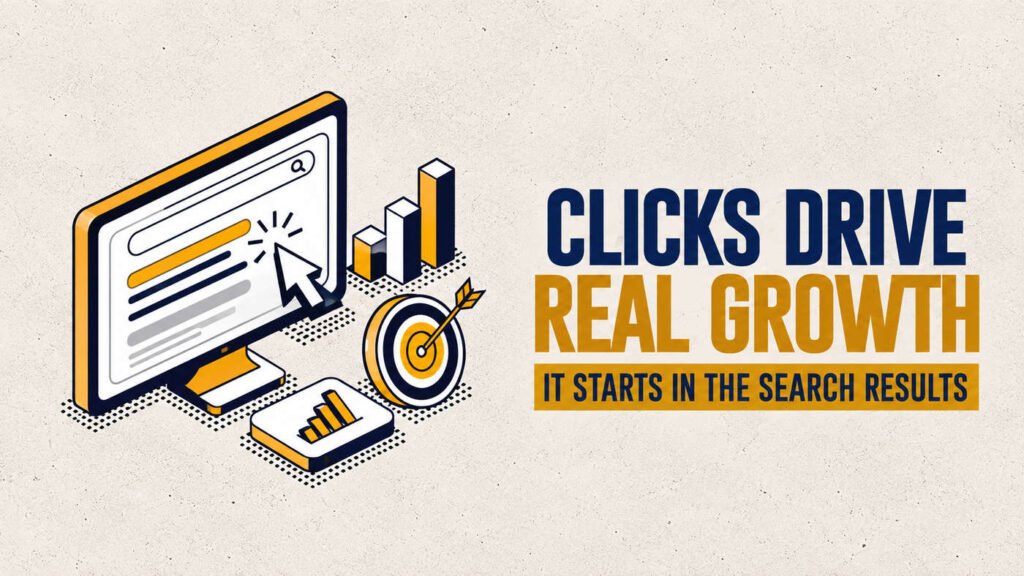
Imagine two websites ranking next to each other. One has a vague title and generic description. The other immediately explains what the page offers and why it’s useful. Even if both occupy similar positions, the second result is usually more likely to attract the click.
Several factors influence that decision:
- Titles that clearly reflect the user’s intent
- Meta descriptions that explain what the page actually offers
- Recognisable brands that have earned trust over time
- Rich search features such as review ratings, FAQs or publication dates where applicable
- Search snippets that closely match the language people use in their queries
A low CTR does not always indicate poor SEO. Search features, AI-generated summaries, featured snippets and local map results may satisfy a user’s query without requiring a click. Nevertheless, consistently weak click-through rates often suggest that a page is not communicating its value effectively within the search results themselves.
Modern SEO therefore extends beyond achieving visibility. It also involves earning the click by demonstrating relevance, clarity and credibility before the visitor ever reaches the website.
SEO Is a Long-Term Business Asset
Most marketing activities produce results only while you continue paying for them.
Pause a paid advertising campaign and the traffic usually disappears within days. Stop sending email newsletters and engagement gradually declines. Become inactive on social media and your reach often shrinks surprisingly quickly.
SEO behaves differently.
It certainly requires continuous work, but every improvement contributes to something larger than the next month’s traffic report. Each well-written article, technical enhancement, authoritative backlink and satisfied visitor strengthens the website itself. Over time, that website becomes an asset capable of attracting qualified visitors with far less dependence on continuous advertising.
That’s one of the biggest reasons organizations continue investing in SEO despite the fact that it rarely produces overnight results.
Organic Growth Compounds Over Time
There’s an old saying that the best time to plant a tree was twenty years ago. The second-best time is today. SEO follows a similar pattern.
The first few months can feel frustrating. Pages are indexed, but rankings fluctuate. Traffic grows slowly. Results appear inconsistent. Businesses sometimes assume their investment isn’t working when, in reality, the foundation is still being built.
Then something interesting begins to happen. Pages that consistently answer users’ questions start earning backlinks naturally. Search engines develop greater confidence in the website. Internal linking strengthens topic relevance. New content gets discovered and indexed more quickly than before. Growth becomes cumulative rather than isolated.
This is why established websites often continue receiving a substantial percentage of their organic traffic from articles published years earlier. Those pages remain useful because they’re updated, expanded and refined instead of being abandoned after publication.
A detailed guide explaining retirement planning, a comparison of accounting software or a comprehensive troubleshooting tutorial can continue attracting visitors for several years if the information remains accurate and relevant.
SEO Rewards Patience, Not Speed
Businesses entering SEO often ask the same question. “How long before we become visible?” The honest answer is that nobody can guarantee a timeline.
Competition, website authority, technical quality, search intent, industry maturity and content quality all influence how quickly progress happens. A new local business targeting niche searches may see encouraging results within a few months, while a company competing for highly competitive national keywords could require considerably longer.
During that time, the website is already improving. Content libraries expand. Technical issues are resolved. Brand mentions increase. More pages become eligible to appear for long-tail searches. Customer questions are answered more comprehensively.
Those improvements don’t disappear if visibility fluctuates for a particular keyword. They remain part of the website’s overall value. That’s an important distinction because search engines constantly evolve.
Cost Efficiency Improves As SEO Matures
SEO is sometimes described as “free traffic”, however it isn’t.
High-quality SEO demands investment in research, writing, editing, technical optimization, analytics, design and ongoing maintenance. Many businesses also invest in platforms such as Google Search Console, Google Analytics, Ahrefs, Semrush or Screaming Frog to better understand their performance.
Those costs are real. The difference lies in how those investments continue generating returns.
With paid advertising, every additional visitor generally requires additional spending. SEO works more like building infrastructure. Once the foundation exists, future growth often becomes more efficient because existing authority supports newly published content.
A simplified view looks something like this:
- Foundation stage – Time is invested in technical improvements, content creation and establishing topical authority. Traffic growth is usually modest because search engines are still evaluating the website
- Growth stage – Rankings begin improving across multiple topics. Existing pages gain visibility while newly published content benefits from the authority already developed
- Maturity stage – Older pages continue generating qualified traffic, internal links strengthen newer content, and the website becomes increasingly efficient at attracting organic visitors
Good SEO Strengthens the Entire Website
SEO may begin as an effort to improve discoverability, but its practical demands strengthen the website behind the rankings.
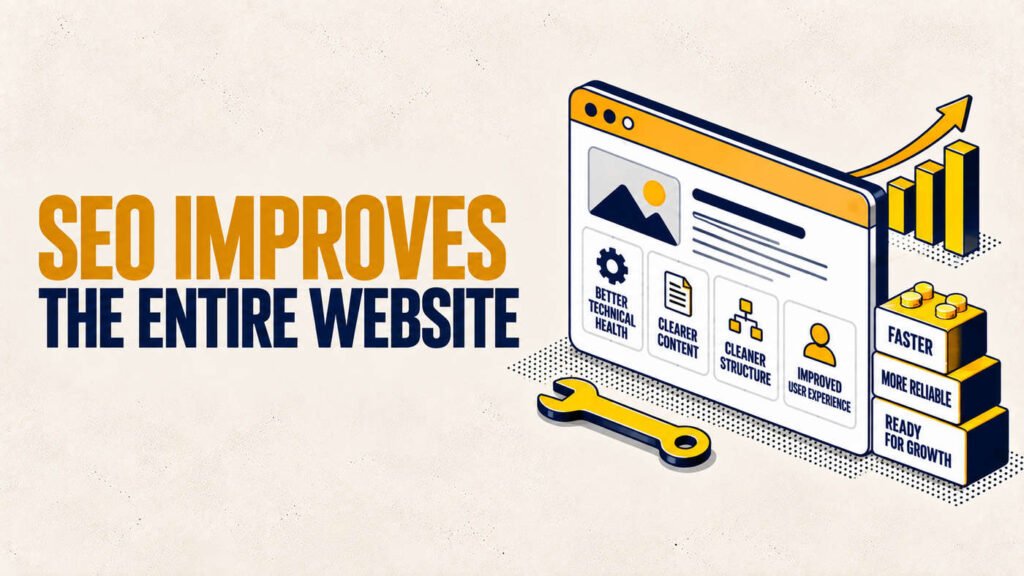
It pushes businesses to remove technical obstacles, organise information clearly, publish genuinely useful content and keep it current. These improvements continue to benefit visitors even when individual rankings fluctuate.
Over time, the website becomes easier to navigate, more dependable and better equipped to accommodate new content, changing customer expectations and future growth. SEO therefore improves not only how a website is discovered, but also how effectively it serves people once they arrive.
User Experience Improves Along the Way
Some people still think SEO revolves around keywords. That may have been true fifteen years ago. Today, many of the most valuable SEO improvements have very little to do with keywords at all. They’re about making a website easier to use.
Imagine arriving on a website that takes eight seconds to load. The navigation menu is confusing. Half the images fail to load. Would you stay? Most people wouldn’t.
Search engines recognise exactly the same problems because they ultimately want users to have positive experiences after clicking a result. That’s why modern SEO increasingly overlaps with user experience design.
A technical SEO audit often uncovers issues that affect visitors just as much as rankings.
Common examples include:
- Slow-loading pages that frustrate users before the content even appears
- Broken internal links that interrupt navigation and reduce confidence in the website
- Poor mobile layouts that force visitors to zoom, scroll sideways, or repeatedly tap the wrong buttons
- Confusing site architecture that makes important pages difficult to find
- Duplicate pages that create uncertainty about which information is current
Search engines have gradually incorporated many of these user experience signals into their evaluation process. Google’s Core Web Vitals, for example, measure aspects such as loading performance, visual stability, and responsiveness because they directly affect how users experience a page. You can measure these metrics using Google’s PageSpeed Insights tool, which also provides practical recommendations for improvement.
Better SEO Usually Produces Better Content
Content creation becomes much easier once SEO shifts the focus from keywords to people. Instead of asking, “Which phrase should we repeat throughout the article?” businesses begin asking much more useful questions, such as:
- What problem is the visitor trying to solve?
- Which information are competitors missing?
- What practical examples would make this explanation clearer?
- What questions will naturally arise after someone finishes reading this page?
These questions almost always produce stronger content. Rather than publishing articles because a content calendar demands another post, businesses start creating resources that answer genuine customer concerns.
That’s one reason many successful SEO strategies revolve around topical authority instead of isolated keywords. A website gradually becomes the place people return to because it consistently explains subjects thoroughly and accurately.
SEO Encourages Continuous Improvement
Unlike a printed brochure, a website isn’t static. Pages can be updated as products evolve, regulations change, customer expectations shift or new research becomes available.
This ability to improve existing content is one of SEO’s greatest strengths.
An article published three years ago doesn’t have to remain frozen in time. It can be expanded with fresh examples, updated statistics, improved visuals or additional FAQs. Existing rankings are strengthened while readers continue receiving accurate information.
Many of the highest-performing pages on established websites have been revised dozens of times. They succeed because they continue becoming more useful.
The Best SEO Strategies Don’t Chase Algorithms
Every major search engine update generates concern. Some websites gain visibility. Others lose it. Businesses naturally want to understand what changed. The temptation is to optimise exclusively for whatever appears to have influenced the latest update.
History suggests that approach rarely works for long. Algorithms change because search engines continually refine how they identify genuinely helpful content. Businesses that focus exclusively on technical loopholes often experience short-lived success before the next update removes those advantages.
Organizations that concentrate on users tend to be far more resilient. When content is accurate, useful and written by people who understand the subject, algorithm updates are generally less disruptive because the website already aligns with the direction search engines are moving.
It’s a slower approach. But it is also the more sustainable one.
Smaller Businesses Can Compete Surprisingly Well
Large brands certainly enjoy advantages. They often have bigger budgets, stronger brand recognition and larger marketing teams.
But SEO has always rewarded expertise in ways that many other marketing channels cannot.
A specialist accounting firm can publish more practical tax guidance than a multinational consultancy. A local cycling shop may write better maintenance tutorials than a national retailer because its staff repairs bicycles every day. A cybersecurity startup might produce deeper technical content than a large software company focused primarily on sales.
Search engines increasingly recognize this kind of firsthand expertise and this creates opportunities that aren’t determined solely by advertising spend or company size. Businesses that consistently execute well often outperform competitors with far greater resources. That’s one of the reasons SEO remains attractive to startups, niche publishers and growing businesses.
Local SEO Turns Searches Into Real Customers
Not every search has a global audience.
A person searching for “best cardiologist near me” or “emergency electrician in Chandigarh” isn’t interested in businesses hundreds of kilometres away. They want someone nearby who can solve their problem today.
Search engines recognize this immediately. Instead of showing only webpages, they display maps, business profiles, customer reviews, opening hours, photographs, directions and contact information. For many local businesses, these search results generate more phone calls and walk-in customers than their website itself.
A properly optimized local presence usually includes:
- A complete and regularly updated Google Business Profile with accurate contact information, business categories and operating hours
- Consistent business details across directories and review platforms so search engines can confidently verify the company’s identity
- Genuine customer reviews that demonstrate trust while helping prospective customers make informed decisions
- Location-specific content that reflects the communities the business actually serves instead of targeting broad national keywords
Consider someone whose car breaks down while travelling. They’re unlikely to spend half an hour comparing service providers. They’ll search for the nearest mechanic, glance at reviews, check whether the business is open and make a call.
For many local businesses, that single search can mean the difference between winning a customer and losing one to a competitor.
AI Search Makes High-Quality SEO Even More Important
Perhaps the biggest change happening today is the rapid growth of AI-powered search experiences.
AI systems don’t create knowledge on their own. They rely on information published across the web. To generate reliable responses, they look for content that demonstrates expertise, cites trustworthy sources, explains concepts clearly and provides genuine value to users. In many ways, these are the same qualities that search engines have been rewarding for years.
That means the fundamentals of good SEO haven’t become less important. They’ve become more important.
Businesses that invest in original research, practical insights, well-structured content and topical authority are more likely to be referenced, cited or surfaced by both traditional search engines and AI-driven search experiences. Those relying on thin, generic or outdated content may find it increasingly difficult to remain visible.
The objective hasn’t changed. People still need trustworthy information. Only the method of delivering that information is evolving.
SEO Builds Visibility Beyond Traditional Rankings
Ranking first for a competitive keyword is still valuable. But rankings alone no longer define SEO success.
Today’s search results go well beyond the conventional list of ranked webpages. Every opportunity for a potential customer to discover, recognize or interact with your brand through search contributes to your overall online presence.
Modern SEO is therefore focused on building comprehensive search visibility rather than improving a single ranking. This includes:
- Featured snippets that answer questions directly within the search results
- Local map listings that generate phone calls without a website visit
- Video results that educate prospective customers before they reach the website
- Image search, shopping listings or knowledge panels that increase brand recognition
- AI-generated summaries that cite authoritative sources while introducing users to new brands
Collectively, these touchpoints strengthen your digital presence and create more opportunities to connect with potential customers at different moments of discovery.
Search Data Is Business Intelligence
Every search tells a story. Every day, millions of people turn to search engines with questions, problems and purchase intentions. Collectively, those searches form a vast body of behavioural evidence that businesses can analyse.
This information is far more than SEO data. It reveals customer priorities, changes in demand and patterns that may not yet be visible through conventional business reporting.
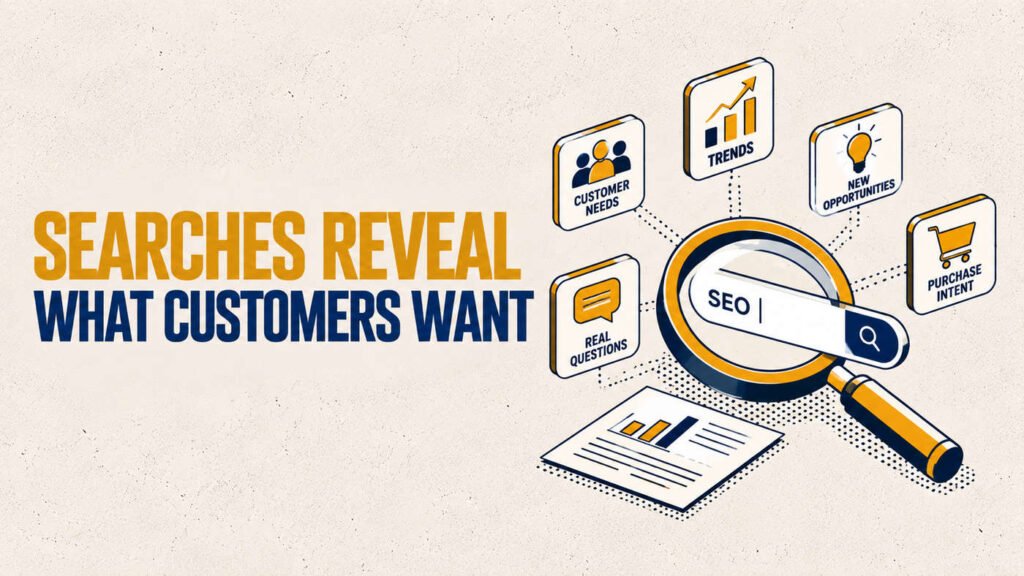
Keyword Research Reveals Customer Intent
Keyword research isn’t simply about finding phrases with high search volume. It offers a direct window into what customers care about, the language they naturally use and the questions they struggle to answer.
This insight goes well beyond creating SEO-friendly content. It helps businesses identify information gaps, refine their messaging and prioritise the topics most relevant to their customers.
Unlike surveys or focus groups, people aren’t responding to prepared questions. They’re revealing their intentions voluntarily.
Search Trends Reveal Changing Demand
Customer priorities rarely stay the same. Economic conditions change. New technologies emerge. Regulations evolve. Consumer preferences shift.
Search behaviour often reflects these changes long before they become obvious through traditional market research.
For example, a steady increase in searches for “AI meeting assistants” or “passwordless authentication” indicates growing interest in those topics. Businesses monitoring search trends can identify opportunities much earlier than competitors relying solely on historical sales reports.
Seasonality becomes easier to understand as well. Retailers can anticipate festive demand. Travel companies can identify emerging holiday destinations. Financial advisers often recognize tax-related interest weeks before filing deadlines.
SEO Insights Extend Beyond Marketing
Many organizations initially invest in SEO to attract more visitors. Over time, however, they often discover that the insights generated through SEO have value far beyond improving search visibility.
Search data helps businesses better understand their customers, identify emerging opportunities and make more informed decisions across different functions. As a result, SEO becomes not just a marketing activity but a source of intelligence that supports business growth in multiple ways.
Some practical applications include:
- Product development – Search trends often highlight recurring customer frustrations, unmet needs or desired features before they appear in formal feedback channels
- Content planning – Editorial calendars become evidence-based because topics are prioritized according to demonstrated user demand rather than assumptions
- Sales messaging – Businesses begin speaking the language customers naturally use instead of relying exclusively on internal terminology or technical jargon
- Market research – Search data complements surveys, interviews and sales figures with a continuously updated view of real-world interest
The Best Decisions Are Based On Real Behaviour
Every business has opinions. A product manager believes customers want a new feature. A salesperson feels demand for a particular service is increasing. The marketing team is convinced a certain topic deserves attention.
Sometimes they’re right. Sometimes they aren’t.
The difference between a good decision and an expensive mistake often comes down to one thing: evidence. When the same search patterns appear thousands of times, they become difficult to dismiss as coincidence.
Those patterns can validate an existing idea before resources are invested. Just as importantly, they can challenge assumptions that aren’t supported by actual customer behaviour. A recurring search may justify launching a new service. An unexpected trend could reveal demand for a product feature that competitors haven’t noticed. Repeated customer questions might expose gaps in existing content, documentation or support resources.
Instead of asking, “What do we think customers want?”, businesses should ask, “What are customers already telling us through their searches?” That question helps organizations test ideas against observed demand before committing resources.
SEO Supports the Entire Customer Journey
One of the biggest strengths of SEO is that it rarely influences just one moment in the buying process.
People don’t usually wake up, search once and make a purchase five minutes later. Most decisions unfold over time. Someone first realizes they have a problem, starts researching possible solutions, compares different providers, looks for reviews, evaluates pricing and finally decides whom to trust.
Search plays a role throughout that journey.

Businesses that understand this don’t create a single sales page and hope it ranks. They build an ecosystem of content that answers different questions as customers become progressively more informed.
A software company, for example, may publish an introductory article explaining why project management tools matter. The same visitor later searches for feature comparisons, implementation guides, customer reviews and pricing information before requesting a product demonstration. Each search reflects a different level of confidence.
SEO allows a business to remain visible throughout that process instead of appearing only at the final stage.
Different Searches Reflect Different Intent
Although every customer’s journey is unique, search behaviour usually follows recognisable patterns. Someone considering solar panels might begin with broad educational questions before gradually narrowing their focus:
- Awareness – “How do residential solar panels work?” or “Are solar panels worth installing?”
- Consideration – “Best solar panel brands in India” or “Monocrystalline vs polycrystalline panels”
- Decision – “Solar panel installation company in Chandigarh” or “Residential solar panel cost estimate”
Notice how the intent changes. The first search seeks knowledge. The second compares available options. The third signals readiness to speak with a supplier.
Businesses that publish useful content for every stage naturally create more opportunities to earn trust before asking for a sale. That’s a very different approach from relying solely on product pages.
SEO Reduces Friction During Decision-Making
Every purchase involves questions, comparisons and uncertainty. Good SEO addresses those concerns before a prospective customer contacts your business.
Someone who has already read your buying guide, compared available options, watched your demonstration video and understood your pricing philosophy arrives with fewer uncertainties than someone encountering your business for the first time.
That benefits both sides. Customers make more informed decisions, while sales teams spend less time explaining basic concepts and more time discussing specific requirements.
In many industries, prospects arriving through organic search have already invested considerable time researching independently. They’re not looking for a general introduction. They’re looking for reassurance that they’ve found the right provider. By providing the right information at every stage of the search journey, SEO removes unnecessary barriers and makes decision-making easier for both customers and businesses.
Trust Grows Through Consistency
Trust is rarely established through a single article. It develops through repeated positive experiences. Someone discovers your website while researching a broad topic. A week later they return after finding another article. A month later they search specifically for your company because your content has consistently answered their questions more clearly than anyone else’s.
That progression isn’t unusual.
It’s one of the reasons brand searches often increase alongside successful SEO campaigns. People begin remembering the business behind the information. Eventually they stop searching only for products or services and start searching for the brand itself.
At that point, SEO has achieved something much more valuable than a click. It has built familiarity.
SEO Supports Existing Customers Too
The customer journey doesn’t end after a purchase. People continue searching for setup guides, troubleshooting advice, maintenance instructions, product updates and best practices long after becoming customers.
Businesses that continue publishing genuinely useful resources strengthen customer relationships while reducing support costs. A detailed knowledge base may answer hundreds of recurring questions before they ever reach the support team. An implementation guide can help new clients achieve success more quickly. A regularly updated resource centre encourages existing customers to keep returning, increasing satisfaction as well as retention.
Viewed this way, SEO contributes far beyond customer acquisition. It supports education, customer success, retention and long-term loyalty.
The Enduring Value of SEO

Search engines, user behaviour and technology will continue to evolve. The strategies that succeed today may not be identical to those that work five years from now. What doesn’t change is the purpose of SEO: helping people discover relevant, trustworthy information when they need it.
Its enduring value lies in adaptability. A strong website can respond to new formats, behaviours and technologies without rebuilding its entire digital presence each time search changes. Ultimately, SEO is about creating a digital presence that continues to earn attention, trust and customers as the way people search evolves.