Backlink pricing has always been a strange part of SEO. Ask three SEO professionals how much a backlink costs and you will likely get three different answers. One person says $50, another says $500, someone else says $2,000, and oddly enough, all of them could be correct.
That usually confuses businesses during their first link-building campaign.
A website owner might think they are buying the same thing in every case. After all, a backlink is just a hyperlink pointing from one site to another. Why would one cost less than a restaurant dinner while another costs more than a laptop?
Because a backlink is not a commodity.
You are not buying a piece of code. You are paying for access, authority, trust, editorial placement, audience value, effort, relationships and sometimes scarcity.
I once saw a company receive a quote of nearly $900 for a single link placement on an industry website. They thought the agency was trying to overcharge them. A week later another vendor offered “50 high DA backlinks” for $80.
The cheaper package looked attractive. Six months later, the expensive option would probably still be helping rankings. The $80 package had disappeared together with half the websites that hosted those links.
That is usually where the lesson begins.
Why Backlink Prices Vary So Much
Backlinks operate in a market with very uneven pricing. Unlike buying advertising where inventory often follows a structured rate card, link-building rarely works that way. A website owner, publisher, agency, outreach specialist and freelancer may all be involved before a link reaches the final buyer. Every additional step can increase cost.
And different websites assign different values to their own authority.
Industry studies and market observations regularly show backlink prices ranging from under $50 to well beyond $1,500 for a single editorial placement. Some high-authority publications or digital PR campaigns go much higher than that, as discussed in Authority Builders backlink pricing analysis.
But averages only tell part of the story. The real question is not how much backlinks cost. The real question is why they cost what they cost.
Typical Backlink Price Ranges
So, what should you realistically expect to pay? While there is no universal rate for a backlink, the ranges below offer a useful snapshot of how different types of placements are typically priced.
Link Type | Approximate Range |
Low-authority blog links | $50 to $150 |
Mid-level niche sites | $150 to $500 |
High-authority editorial sites | $500 to $1,500+ |
Premium digital PR placements | $1,500 to several thousand dollars |
Pricing often increases with domain authority, organic traffic, industry competition, content requirements as well as outreach effort.
At first glance, these differences can seem arbitrary. Why should one website charge a few hundred dollars while another charges several times more? In most cases, the answer is not the link itself. It is everything behind the link.
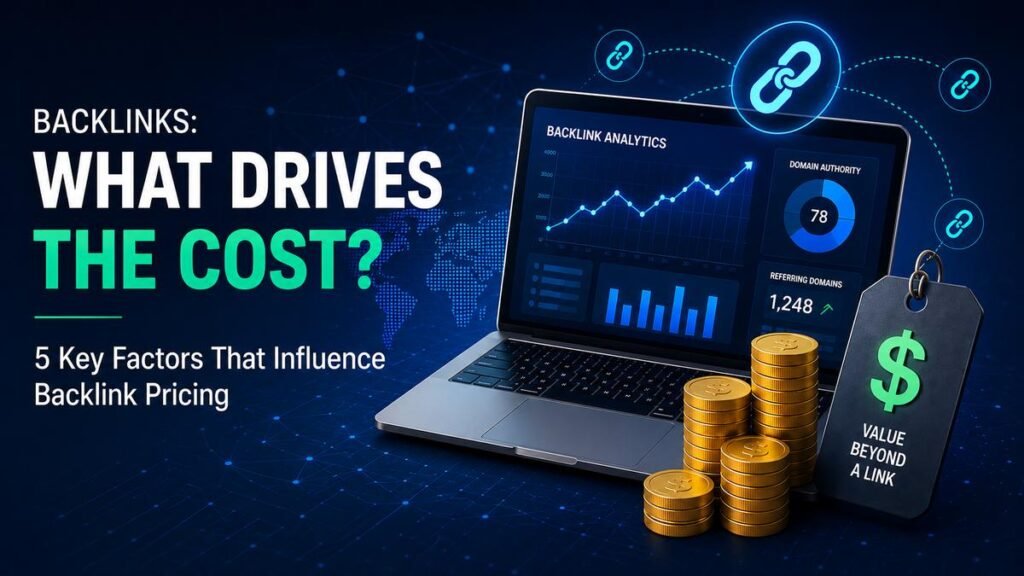
The Five Major Pricing Drivers
The differences become clearer once you break the market down. Some factors influence the perceived value of a backlink, while others affect the work and cost involved in securing it. The following factors tend to matter most.
1. Website Authority and Organic Traffic
This is usually the first thing buyers notice. A website with strong authority and consistent organic traffic almost always charges more.
SEO professionals frequently use metrics like:
- Domain Rating or DR from Ahrefs
- Domain Authority or DA from Moz
- Estimated organic traffic
- Referring domains
- Topical authority
You can explore these metrics using tools such as Ahrefs or Moz. But there is a catch! Many SEO professionals become obsessed with DR numbers, and that creates problems. A DR 70 website with 300 monthly visitors may be less valuable than a DR 40 website receiving 100,000 relevant visitors every month. Search engines care about signals that resemble genuine trust and relevance. They do not read DR scores from SEO tools.
Think of it like buying real estate. Two houses can have similar square footage. One sits in a crowded neighbourhood nobody visits, while the other stands in a busy area where people actually live and work. The addresses matter.
Backlinks work similarly. High-traffic, trusted sites generally command premium pricing because demand is higher and the perceived SEO value increases.
Traffic quality matters too
Not all traffic carries equal value. A website receiving 500,000 visitors from irrelevant countries, or traffic generated by automated methods, may still perform poorly as a link source.
Buyers increasingly analyze:
- Geographic relevance
- Keyword rankings
- Traffic trends
- Audience behaviour
Some websites with impressive metrics look excellent from the outside, yet their traffic charts resemble a roller coaster. That usually deserves closer inspection.
2. Relevance of the Linking Website

A decade ago, link building sometimes felt like collecting trading cards. People wanted more links. Then search engines became smarter, and context started mattering far more than sheer quantity.
Suppose you run a cybersecurity company. Which backlink would seem more natural? A link from a technology publication discussing network security or a random gardening blog? The answer is obvious.
Relevance affects both value and price.
Links from websites operating in the same niche often cost more because:
- They are harder to acquire
- They provide stronger contextual signals
- They look more natural
Google has repeatedly discussed the importance of useful and relevant linking relationships through documentation available at Google Search Central
And this creates an interesting effect in competitive sectors. Finance, legal, SaaS, healthcare and insurance websites frequently pay much higher link prices because relevant placements are limited. Scarcity changes markets.
3. Link Type and Placement Style
Not every backlink appears the same way. Placement type affects cost considerably.
Guest post links
These involve publishing a completely new article that contains your link. Prices rise because someone has to write content, edit content, review content as well as publish content.
You are paying for more than the hyperlink itself.
Niche edits or link insertions
This means placing your link into an existing article.
These are often cheaper because no new content creation is required. But sometimes they become expensive if the existing page already has strong rankings and traffic.
Homepage links
Homepage placements are usually premium inventory. They are more visible and sometimes pass stronger signals.
Resource page links
These appear inside curated lists, tools pages or educational references. Some can be extremely valuable. Others exist purely for selling links.
The difference is often visible after a few minutes of analysis.
4. DoFollow vs NoFollow Attributes
People often assume nofollow links are worthless. That belief became popular years ago. Reality is more complicated.
A nofollow attribute tells search engines not to pass traditional authority signals directly. A dofollow link generally transfers stronger ranking value, so buyers usually pay more for it.
But nofollow links still have uses.
Imagine receiving a mention from a major publication. Even if the link is nofollow, it can send referral traffic, build visibility, increase brand recognition as well as contribute indirect SEO value.
Some businesses happily pay for these opportunities because real marketing rarely exists inside perfect categories.
5. The Number of Middlemen Involved

This factor is often ignored, yet it quietly affects pricing.
Consider a simple scenario. A website owner sells a link directly for $80.
Then:
- A freelancer purchases access
- An outreach company adds its margin
- An agency adds another margin
- A reseller adds another percentage
Suddenly that $80 link becomes $400. Or more.
This chain effect happens more frequently than people realize. Multi-layer markups can dramatically inflate costs across the link-building market.
That does not automatically mean agencies are overcharging.
Many agencies provide:
- Prospect research
- Outreach management
- Content production
- Quality checks
- Relationship building
- Reporting
Those services require time and expertise. But buyers should understand what exactly they are paying for.
Hidden Factors That Also Influence Pricing
The five major factors explain much of the market, though several smaller elements can still affect final costs.
Industry competitiveness
Some niches practically run on expensive links.
Legal websites, casinos, insurance platforms and finance businesses often compete in markets where everybody is investing heavily. A link that costs $150 in one niche may cost $800 elsewhere.
Content requirements
Some publishers require long-form articles, original graphics or expert contributions. Content creation adds cost quickly.
Geographic targeting
Links from websites targeting countries like the United States, Canada or the United Kingdom frequently cost more because competition and demand are higher.
Editorial standards
Some websites maintain strict review processes. Getting approved on those sites takes more effort, and effort has a price.
Cheap Backlinks Usually Have a Story Behind Them
People naturally look for discounts. Nothing unusual there.
But backlink marketplaces can sometimes feel like street markets selling luxury watches for ten dollars. That should raise questions.
Very cheap links often come from:
- Private blog networks
- Expired domains repurposed for selling links
- Automated systems
- Low-quality guest-post farms
- Websites built only for monetizing links
Some of these websites look impressive at first glance, with strong DR scores, polished designs as well as large content libraries.
Then you notice something odd. A travel article links to a crypto company, a plumbing service and a casino website in the same paragraph. That usually tells its own story.
Should You Buy Backlinks at All?
This question creates endless debates in SEO circles.
Technically, buying links intended to manipulate rankings goes against search engine guidelines. Google discusses link spam policies at Google Search Essentials
Yet the real-world landscape is more nuanced.
Many businesses invest in digital PR campaigns, sponsored collaborations, guest contributions, content promotion as well as outreach campaigns. Money often enters the process somewhere.
The difference usually comes down to quality and intent. Buying random links in bulk differs greatly from investing in content and outreach that earns credible placements.
How to Judge Whether a Backlink Is Worth the Price
Before paying for any link, ask a few practical questions:
- Does the website receive genuine traffic?
- Is the topic relevant to my niche?
- Would I still want this link if search engines did not exist?
- Does the site appear trustworthy?
- Are outbound links placed naturally?
- Does the website have real readers?
That last question matters more than many realize because backlinks originally existed for people, not algorithms. Search engines simply followed.
The Cost of a Bad Link Can Be Higher Than the Cost of a Good One
People often focus only on acquisition cost. But the larger expense sometimes appears later.
Low-quality links can create:
- Wasted budgets
- Ranking instability
- Cleanup work
- Time loss
- Reputation damage
And cleaning a backlink profile is rarely enjoyable. Ask anyone who has spent weeks analyzing spam links inside Google Search Console
They usually have stories. Quite a few of them unpleasant.
Backlinks are not priced according to a universal formula. They behave more like assets in an open market where authority, relevance, demand and effort all influence value. The link itself may only occupy a few words in an article, but what sits behind it can be far larger.