I started blogging in 2010, back when keyword research was the whole game. You found a phrase with decent volume and weak competition, wrote the best page for it, built a few links and waited. It worked. So when I moved seriously into YouTube and grew my channel (@Ismailvlogger) to 377K subscribers, I carried that same habit with me.
It took me far too long to notice that the habit was costing me.
On YouTube, the keyword with the biggest number is often the worst topic you can pick. The ideas that actually grew my channel, and the ones I now see working for the 33,000+ students in my Udemy courses, almost never came from a search volume column. They came from studying videos that did far better than they had any right to.
Those videos are called outliers. In this article I’ll explain what they are, why they beat classic keyword research for topic selection in 2026, and the exact workflow I use to turn them into videos.
Why keyword-first YouTube SEO is getting weaker
Keyword research still has a job. It just isn’t the job most people give it.
YouTube says its search ranking looks at three main things: relevance, engagement and quality. You can read that in YouTube’s own explanation of search and discovery. Notice that only one of those three is about matching words. The other two are about what viewers do after they click.
Then there’s the bigger point. Most views on YouTube don’t come from search at all. They come from the home feed and suggested videos, which are driven by what YouTube calls viewer satisfaction. In its post on how the recommendation system works, YouTube describes using signals like clicks, watch time, survey responses, shares, likes and dislikes. A keyword can get you indexed. It can’t make people want to watch.
So here’s the gap. A keyword tool tells you what people type. It says nothing about which angle, title or format makes them click and stay. That’s exactly the gap outliers fill.
What an outlier video actually is
An outlier video is a video that gets many more views than its own channel normally gets.
The math is simple. Take the video’s views and divide by the channel’s typical views per video. I prefer the median of recent uploads over the average, because one old viral hit can inflate an average and hide every new breakout.
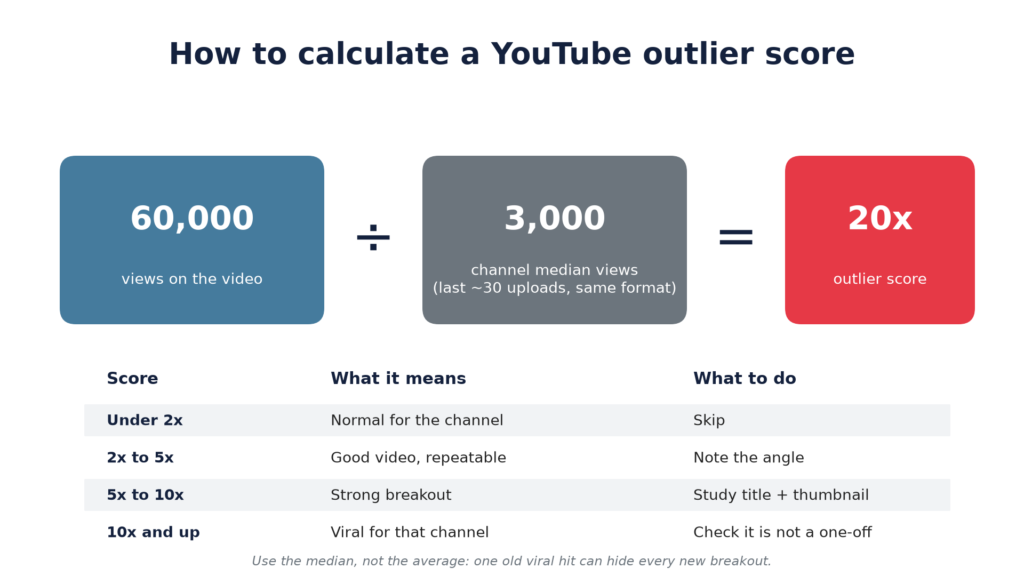
A quick example. A video with 1,000,000 views on a channel that usually gets 900,000 is a normal day. A video with 60,000 views on a channel that usually gets 3,000 is a 20x outlier. The second one is far more useful, because nothing carried it except the idea. No big subscriber base. No brand. Just a topic and packaging that viewers wanted.
Why outliers outperform raw search volume
There’s now decent public data on this.
In a 2026 analysis, OverseerOS looked at 2,622 YouTube uploads across 59 channels and found 277 breakouts, meaning videos that beat their channel baseline by more than 2x. Three findings stood out to me:
- 54.2% of breakouts had fewer than 50,000 views. Most real breakouts are invisible if you only sort by views
- 64.3% of the million-view videos were not breakouts for their channels. Big channels were just doing big-channel numbers
- 81.6% of breakouts landed between 2x and 5x. Only 4.7% hit 10x or more
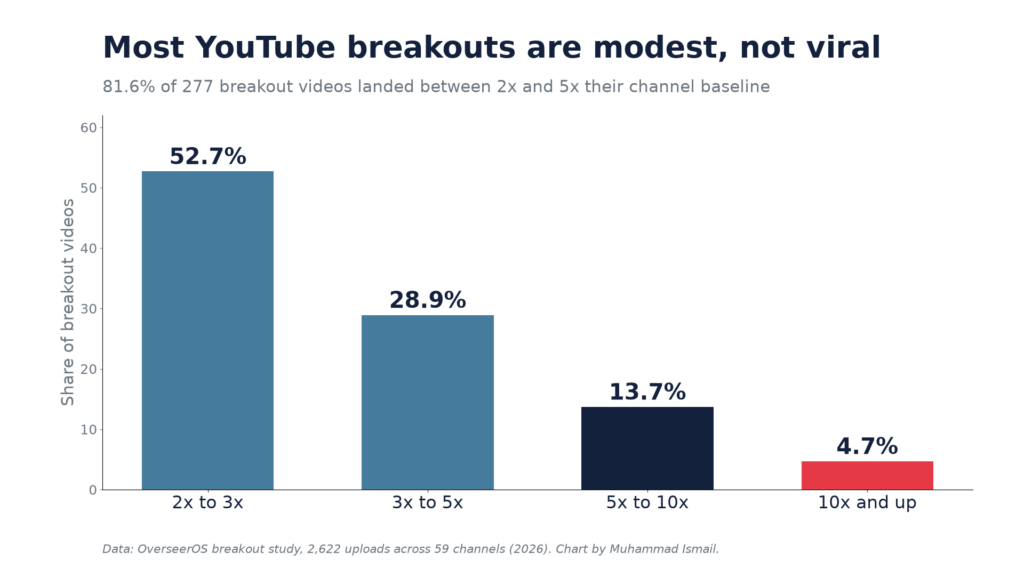
That last point changed how I research. I used to hunt for the one giant viral video. Now I look for steady 2x to 5x patterns, because those are the ones a normal channel can repeat.
Our own data at TubeMind tells a similar story. In a November 2026 study of 912,069 videos uploaded between May and October 2026, 9.96% reached 5x their channel median and only 1.22% reached 50x. The median video earned 0.95x its channel’s usual views. In plain words, most uploads land slightly below normal. That’s why a real breakout is such a strong signal. The niche matters too: 13.69% of Nature and Animals videos hit 5x, compared with 1.85% in Crypto. The study also breaks down the findings across 31 niches.
This is the kind of insight keyword research alone can miss. Take a topic like “How to start a YouTube channel”. A keyword tool may show huge search volume, but it also has thousands of competing videos, many from channels with years of authority. The volume is real. Your share of it is not.
A simple 5-step outlier workflow
This is the process I use and teach. It takes about an hour once you get used to it.
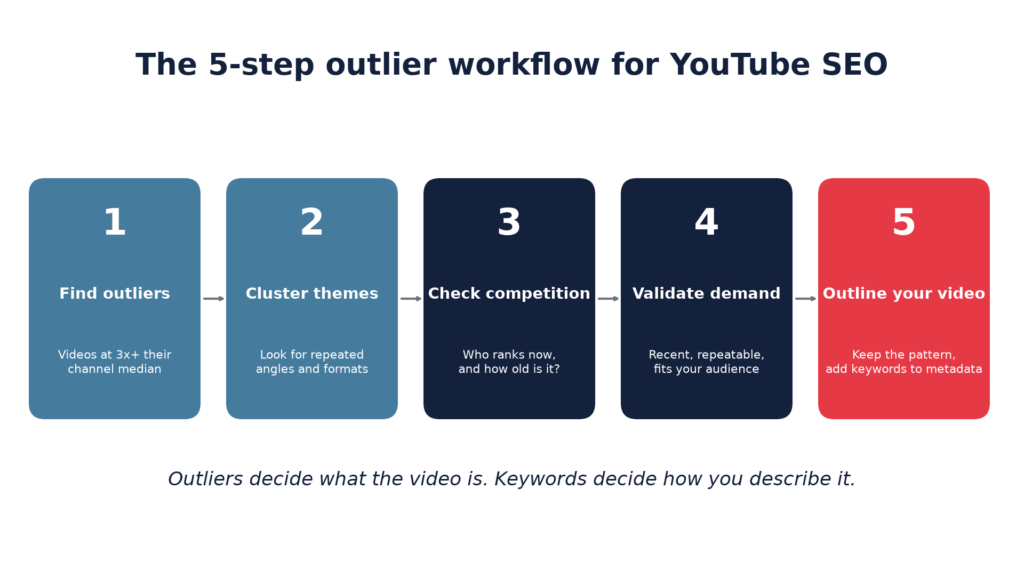
Step 1: Find outliers in your niche
Start with 10 to 20 channels in your niche, ideally a mix of small and mid-sized ones. For each, compare recent videos against the channel’s median views. You can do this by hand in a spreadsheet. It’s slow but it works. Or you can use a tool that does the math for you. Either way, note anything above 3x.
Small channels are gold here. A 15x video on a 4,000-subscriber channel is a cleaner signal than a 3x video on a channel with millions of subscribers.
Step 2: Cluster the themes
One outlier is a data point. Three outliers on the same idea is a pattern.
Put your outliers in a list and group them. You’re looking for repeated angles, not repeated titles. For example, in the personal finance space you might see “I tried living on X for 30 days” winning across several unrelated channels. That’s a format. Formats travel well. A single lucky title usually doesn’t.
Step 3: Check competition
Now bring keyword research back in, but in a supporting role. Search the theme on YouTube and look at the first page. Who ranks? How old are those videos? Are they from huge channels or small ones like yours?
If the top results are recent videos from channels your size, that’s a good sign. If it’s five-year-old videos from giant channels, you’ll probably need a sharper angle.
Step 4: Validate demand
Ask two questions. Is this idea still getting views now, or was it a spike? And does it fit your audience?
Look at when the outliers were published. If they’re all from the last few months, the idea is live. If the newest one is two years old, be careful. I also check whether the outlier depended on news, a celebrity or a seasonal event, because those don’t repeat.
Step 5: Outline your video
Take the pattern, not the video. Keep the structure of the title and the core promise. Change the specifics, the examples and the point of view so it’s clearly yours.
Then use keywords where they belong: in the title, description and chapters, so YouTube understands what the video is about. Keyword research decides how you describe the video. Outliers decide what the video is.
Common mistakes to avoid
I’ve made most of these myself.
- Chasing one viral hit – A single 100x video can be luck, timing or an external share. Look for clusters
- Copying titles only – Viewers click because of the title and thumbnail, but they stay because the video delivers. If you copy the title and not the substance, retention drops and the video stalls
- Ignoring retention – An outlier with weak comments and few likes for its views may have been pushed by ads or an outside spike. Check the engagement before you trust it
- Using the wrong baseline – Comparing a Short to a channel’s long-form median gives a fake score. Compare like with like
- Skipping your own audience – An idea that breaks out for US viewers may not work in Urdu or Hindi, and the reverse is also true. Sometimes the regional gap is the opportunity
How keyword research and outliers work together
I don’t want to overstate this. Keyword research isn’t dead. It’s just moved down the funnel.
Think of it like this. Outliers answer the question “what should I make?” Keywords answer “how should I describe it so the right people find it?” When I use both in that order, my videos get a strong idea and clean metadata. When I flip the order, I end up with well-optimized videos that nobody especially wanted.
If you want to go deeper on the outlier side, I wrote a full guide on YouTube outlier videos that covers the multiplier scale and how to spot false outliers.
The takeaway
YouTube SEO in 2026 isn’t about finding the biggest keyword. It’s about finding ideas viewers have already proven they want, then describing them clearly.
Start small. Pick ten channels in your niche this week, find the videos that beat their channel median by 3x or more, and look for the pattern. You’ll probably find more good ideas in one hour than in a month of staring at search volume.
Frequently Asked Questions
Once a week is enough for most channels. Fast-moving niches like tech or gaming may need two short checks a week. Evergreen niches like cooking or DIY can get by with every two weeks.
Yes, but compare Shorts only with Shorts. Shorts break out more often than long videos in our data (10.82% against 8.64% at 5x), so the bar for a meaningful Shorts outlier should be a little higher.
It’s most useful for small channels. You don’t have the subscriber base to make an average idea work, so you need ideas already proven to pull viewers on their own.
Anything above 2x is worth noting. 5x and above is a strong breakout. 10x and above is rare and worth studying closely, but check that it isn’t a one-off news or seasonal spike.
Yes. The same logic works for blog topics and social posts. Find the pieces that beat their publisher’s normal performance, then work out why.