

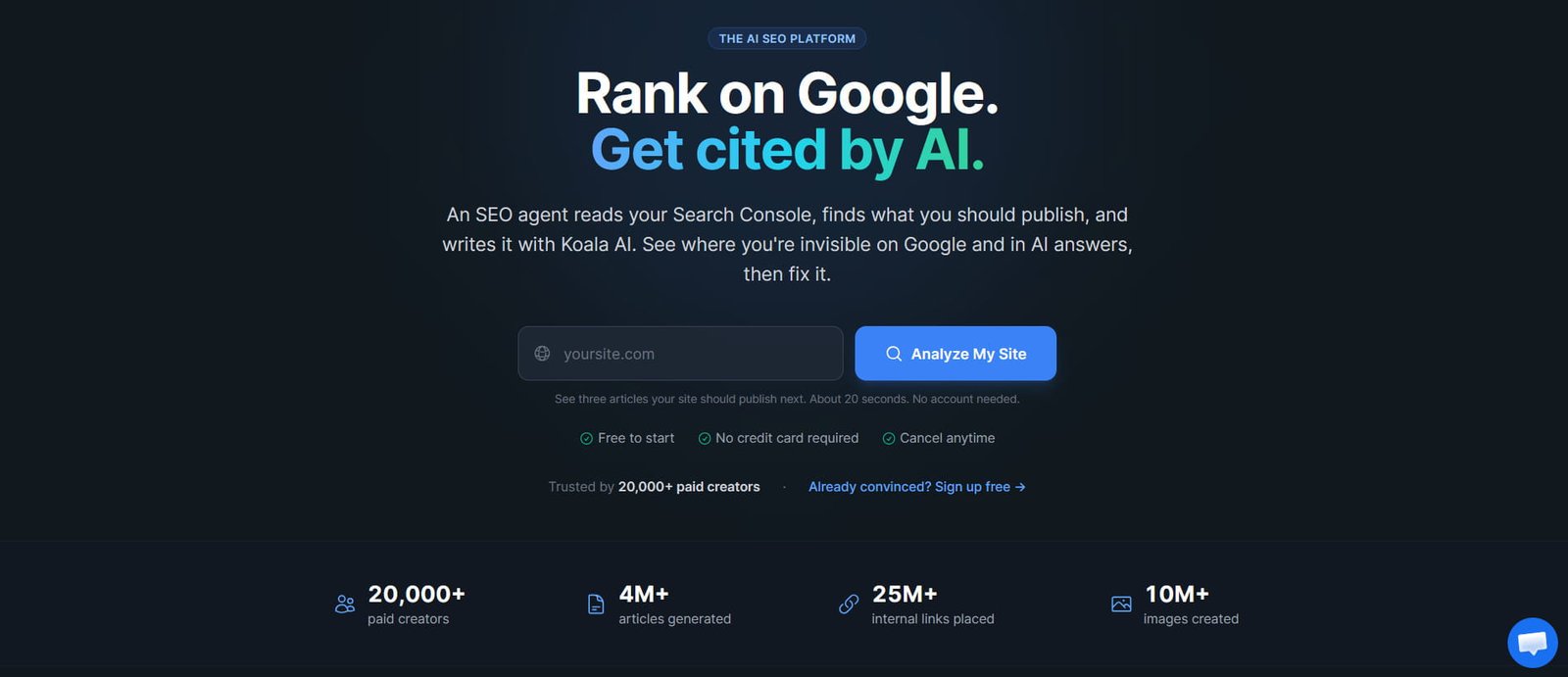
KoalaWriter v2 is a much bigger update than the name suggests. It is still an AI writing tool, but Koala now wants to understand the business it is writing for, handle more of the research and give users greater control before an article is generated.
One of the biggest additions is Brand DNA. Instead of explaining your business, audience and preferences with every article, you can build that information into a reusable brand profile.
The writing engine has also been rebuilt, research goes deeper and the editor plays a larger role in the workflow. KoalaWriter is starting to feel less like an article generator and more like a dedicated SEO content workspace. So, how much better is v2 in practice?
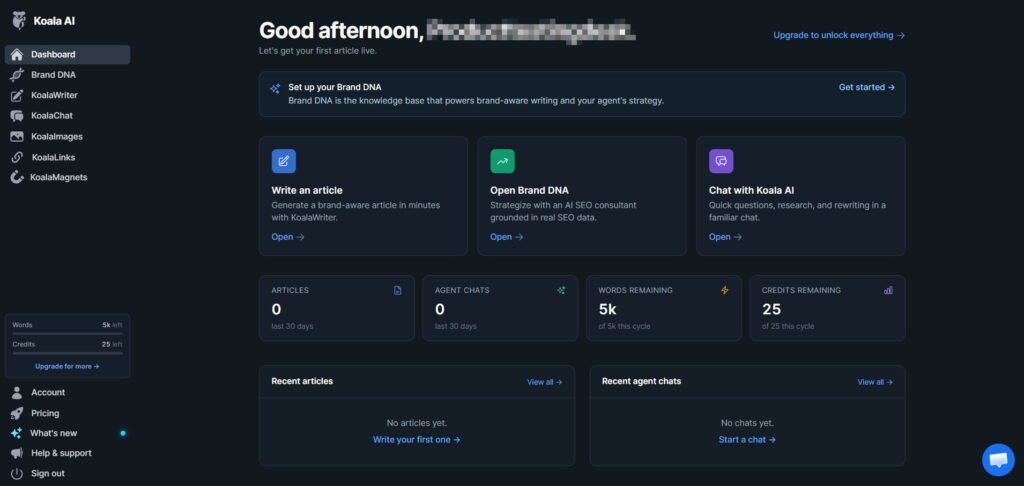
The dashboard makes that broader direction obvious. KoalaWriter now sits alongside the brand tools and KoalaChat, with direct options to write an article, work with the SEO agent or start a chat. Word and credit allowances are displayed on the same screen, along with recent articles and agent conversations.
Despite the wider toolset, the dashboard doesn’t feel particularly crowded. The main actions are easy to find, while everything else stays in the left-hand navigation.
Quick Verdict
KoalaWriter v2 is a strong option for publishers, agencies and businesses producing search-focused content regularly. Better research, stored business context and stronger SEO controls give it advantages beyond simply generating text.
It isn’t a hands-off publishing machine. Content still needs editing and factual claims should be checked. But the overall workflow has become considerably more capable.
Our ratings reflect that. SEO and research are among the strongest areas, while the new brand features add useful context when you’re producing content regularly. Value for money depends more heavily on publishing volume and which features you actually use.
Factor | Rating |
Writing Quality | 4.6/5 |
SEO & Research | 4.7/5 |
Brand Context & Customization | 4.7/5 |
Ease of Use | 4.6/5 |
Value for Money | 4.4/5 |
Overall Rating
|
What Has Actually Changed in KoalaWriter v2?
The biggest change is context, but there is also considerably more control over how an article is produced.
The KoalaWriter screen gives you the expected target keyword, language and country settings, then goes further. You can select a brand, choose between Fast, Balanced and Quality generation, change the article type and provide your own content instructions.
Research and external linking, SEO and internal linking, writing preferences and the inclusion of AI images or YouTube videos can also be controlled from the same screen.
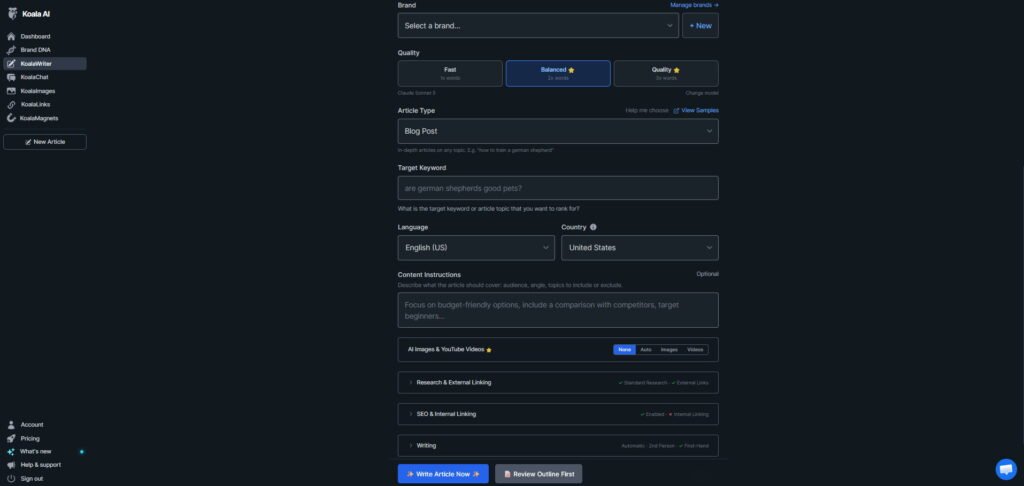
I particularly like that Koala doesn’t force you straight into generation. At the bottom are two clear choices: Write Article Now or Review Outline First.
For serious articles, reviewing the outline first makes more sense. It gives you a chance to catch unnecessary sections or a poor structure before Koala starts consuming your word allowance to write them. The expandable sections are useful here. They keep the more detailed settings out of the way until you actually need them, while the core article setup remains visible.
Brand DNA Is the Feature to Watch
The idea behind Brand DNA is fairly simple: stop teaching the AI about the same business every time you create an article.
A company can build a knowledge base around its services, credentials, FAQs, brand voice and other information that KoalaWriter can draw from when producing content. The interface also provides control over how prominently the business should be mentioned. But the more interesting part is what happens beyond writing.
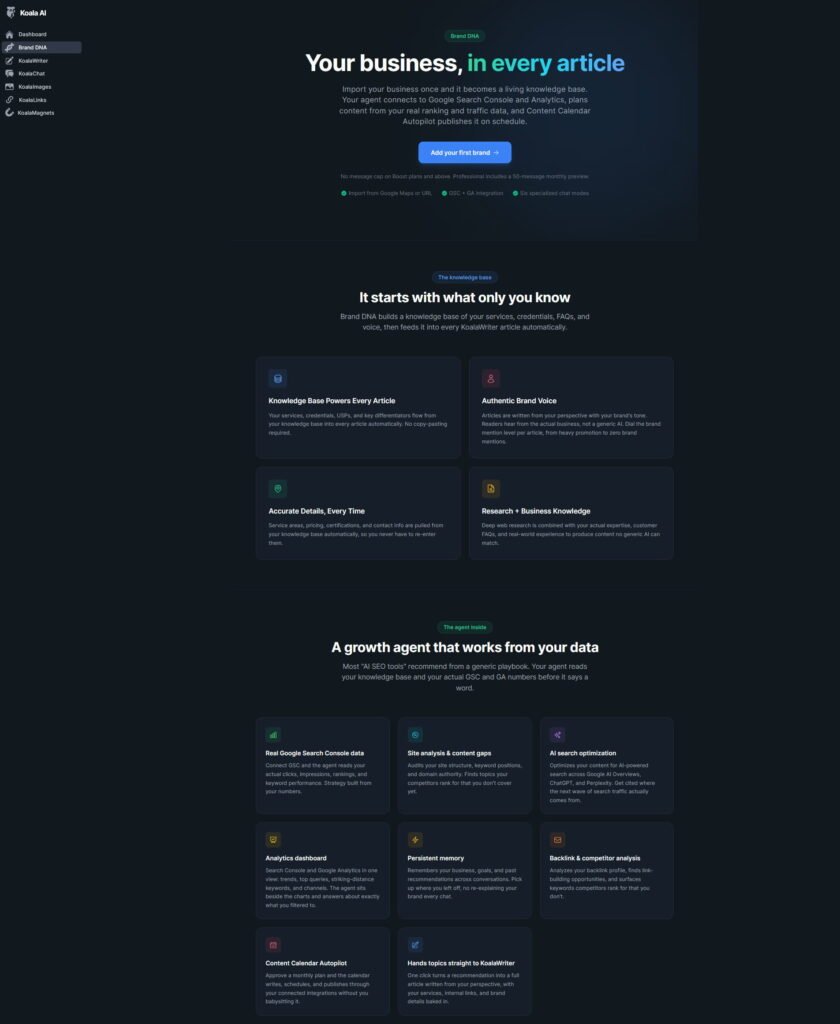
The feature connects with Google Search Console and Analytics and extends into site analysis, content gaps, competitor and backlink analysis, AI-search optimization and an analytics dashboard. This means the agent can work with actual search data alongside the information stored about the business.
That makes it more useful than simply saving a company description for the AI to reuse.
Still, stored business information doesn’t replace good instructions or editorial judgement. Better context gives the AI more to work with; it doesn’t guarantee a better article.
Research Goes Deeper
Research is another area where v2 has improved.
KoalaWriter can pull current information into an article, while Deep Research is designed for subjects where a quick search isn’t enough. That’s useful when writing about changing software features, statistics, prices or recent industry developments.
The convenience shouldn’t be mistaken for verification, though. Sources still need checking, particularly when an important factual claim depends on them. I wouldn’t publish an article simply because the research tool attached citations to it.
SEO Optimization Is More Practical
SEO remains one of KoalaWriter’s stronger features. The platform analyzes search results for the target keyword and looks at relevant entities and terms when developing the article. More importantly, those optimization features sit alongside the outline and research controls rather than being treated as a separate step.
Koala is also making a much bigger play for AI search.

Its current positioning is quite explicit: “Rank on Google. Get cited by AI.” The wider platform combines Search Console and Analytics information with keyword, backlink, competitor and SERP data.
I would keep expectations sensible here. Better structure, evidence and research may make content more useful to AI systems, but no writing platform can guarantee that ChatGPT, Google AI Overviews or another answer engine will cite a particular page.
The Editor Has Become More Useful
The editor now feels more like part of the writing process than somewhere to inspect the finished output.
Articles can be refined using AI-powered editing, while the editor brings writing and SEO feedback closer together. Combined with the ability to review an outline before generation, this gives you considerably more control at both ends of the process. And sometimes these less dramatic improvements matter more than another headline AI feature.
If you’re producing content every week, reducing the number of tools and tabs involved can save a surprising amount of time.
Where KoalaWriter v2 Still Falls Short
The main weakness hasn’t disappeared: AI content can still sound like AI content.
Clean sentences and a logical structure don’t automatically produce insight. Better business context, deeper research and stronger prompts help, but none creates genuine experience or judgement.
Koala’s expanding feature set can also be unnecessary for occasional users. If you publish only a couple of articles each month, you may not need an integrated writing, research, SEO and publishing environment. Its value becomes clearer only as content volume increases.
KoalaWriter Pricing
Koala’s current entry plan is Starter at $25 per month, followed by Professional at $49 and Boost at $99.
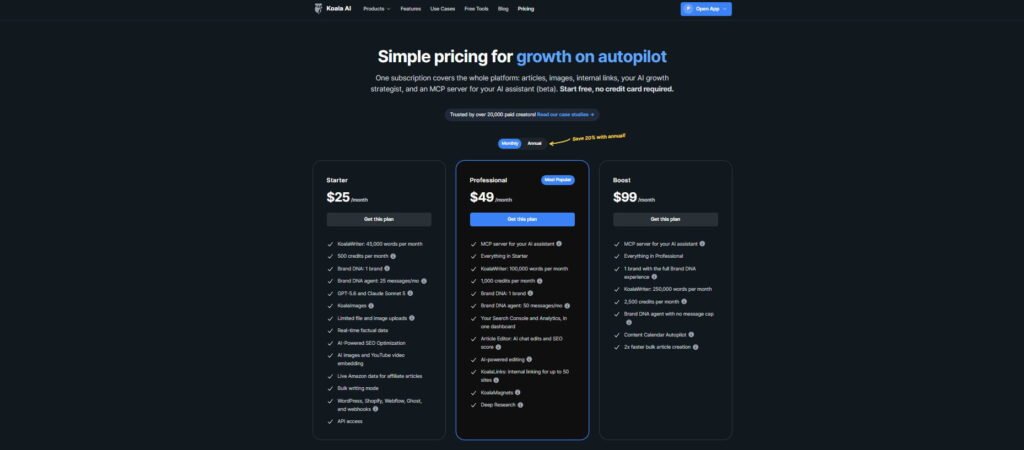
Starter includes 45,000 KoalaWriter words and 500 credits per month. Professional raises that to 100,000 words and 1,000 credits, while adding features such as Deep Research, AI-powered editing and Search Console and Analytics integration.
Boost increases the allowance to 250,000 words and 2,500 credits, adds the full Brand DNA experience, removes the agent message cap and introduces Content Calendar Autopilot.
There is plenty of room above these plans too.
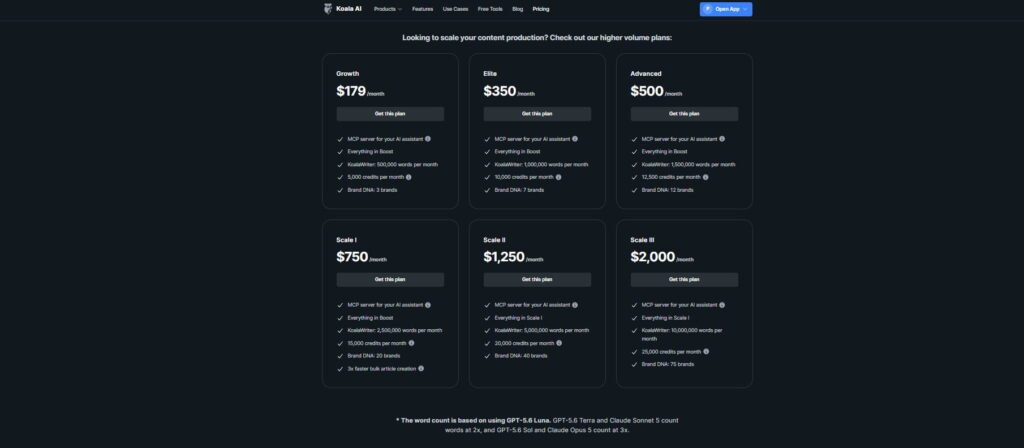
Growth starts at $179 per month with 500,000 KoalaWriter words and three brands. The plans then move through Elite and Advanced into three Scale tiers. At the top end, Scale III costs $2,000 per month and provides up to 10 million words, 25,000 credits and 75 brands.
These clearly aren’t plans aimed at an individual blogger. They make more sense for agencies and large-scale publishing operations.
There is one detail worth understanding before comparing plans purely by word count. Different AI models consume the allowance at different rates. GPT-5.6 Luna uses the base word count, while some more advanced models apply 2x or 3x multipliers.
So 100,000 included words don’t necessarily mean 100,000 words from whichever model you choose.
Is KoalaWriter v2 Worth It?
Yes, particularly if search-focused content is a regular part of your publishing workflow.
KoalaWriter v2 combines writing, research, business context, SEO optimization and editing more effectively than the earlier version. The reusable brand profiles are useful, but the bigger improvement is how the different parts of the platform now work together.
I still wouldn’t generate an article and publish it untouched. But if the goal is to get from a keyword or idea to a researched, structured draft faster, KoalaWriter v2 does a convincing job of reducing the work in between.
Note: This article may contain affiliate links. Please read our full disclosure.
