Search once followed a familiar formula. You typed a query, got ten blue links, clicked one, maybe two, and moved on. That model shaped the entire discipline of SEO for more than two decades.
But the search experience is changing. AI assistants now answer questions directly. They summarize, compare and sometimes recommend for the user before a single click happens.
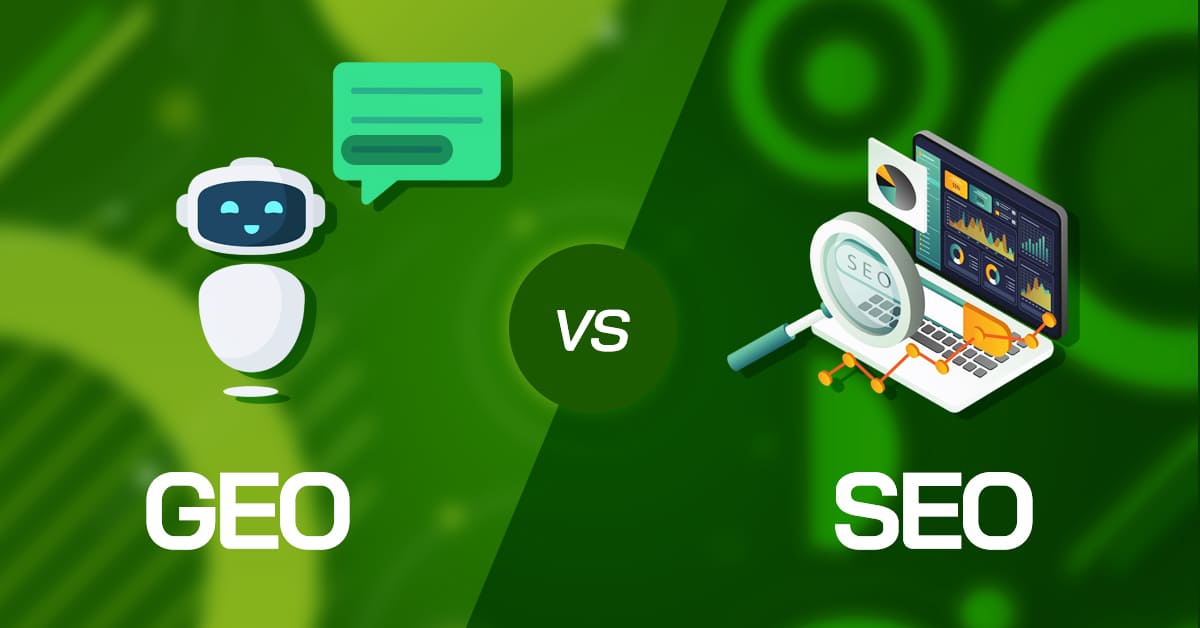
This shift created a new idea: Generative Engine Optimization or GEO.
And now, brands are facing a practical question – should they focus on SEO, GEO or both?
Here’s the short answer: you can’t pick just one anymore.
What is GEO?
Generative Engine Optimization or GEO refers to the practice of optimizing content so it appears inside AI-generated answers rather than just ranking in traditional search results. According to the definition on Wikipedia’s GEO page, it is a strategy focused on visibility within AI-driven search systems.
Instead of trying to win a top-10 position on Google, GEO aims to make your content the source that an AI assistant cites or summarizes. Platforms like ChatGPT, Google Gemini and Perplexity AI already operate this way.
These systems don’t just list links. They synthesize answers from multiple sources, which is fundamentally how generative AI in search operates.
Industry discussions on websites like Search Engine Land and WordStream’s GEO overview point out that GEO focuses heavily on:
- Clear factual statements
- Logical structure
- Contextual explanations
- Citations and authority signals
AI systems aren’t just matching keywords, they’re building answers. And if your content doesn’t fit into that answer, it disappears from the conversation.
What is SEO?
Search Engine Optimization is the process of improving a website’s visibility in traditional search engines such as Google Search, Microsoft Bing and DuckDuckGo.
The goal is simple: rank higher in search results, earn clicks and convert visitors.
SEO works through a combination of signals:
- Keywords and search intent
- Backlinks and authority
- Technical performance
- User experience
- Content quality
For years, the basic model looked like this:
Search → Click → Website → Conversion
And it still works. SEO is not dead, despite what headlines claim every year. Guides like Google’s SEO Starter Guide and resources from Moz still describe the same foundational principles.
Think of SEO as the discipline that helps people find your page.
What GEO and SEO have in common?
Despite the hype around GEO, the two disciplines share more DNA than most people think.
Both are built on the same foundation: useful, trustworthy and well-structured content.
Industry guidance from Google’s ranking systems guide and Google’s E-E-A-T documentation, shows that SEO and GEO rely on similar principles, even though they target different platforms and outcomes.
Here’s where they overlap:
- Content quality matters in both – Search engines and AI systems both prefer accurate, helpful, well-written information
- Authority signals still count – Backlinks, brand mentions and expert sources influence both rankings and AI citations
- Clear structure helps everything – Headings, logical flow and schema markup improve both crawlability and AI content retrieval; see Schema.org for structured data standards
- Topical depth builds trust – Covering a subject comprehensively increases both ranking potential and citation likelihood, a principle also discussed in the Ahrefs SEO guide
Here’s why that matters.
Many people assume GEO is a completely new skill. But in practice, strong SEO foundations are often what make GEO possible in the first place. Analyses on sites like SearchGeeks and Semrush’s SEO resources also emphasize this overlap.
Think of it this way:
If your content isn’t trustworthy enough to rank, why would an AI system quote it?
Key Differences Between SEO and GEO
Aspect | SEO | GEO |
Primary Goal | Rank higher in search results | Get cited or summarized in AI responses |
Main Platforms | Google, Bing, traditional SERPs | ChatGPT, Gemini, Perplexity, AI Overviews |
User Journey | Click through to a website | Read answer directly in AI interface |
Core Signals | Keywords, backlinks, technical SEO | Clarity, structure, authority, factual accuracy |
Success Metrics | Rankings, traffic, conversions | Mentions, citations, AI visibility |
Content Style | Optimized for scanning and SERPs | Optimized for extraction and synthesis |
Output Format | List of links | Single synthesized answer |
How To Make GEO and SEO Work Together
The smartest approach isn’t choosing one over the other. It’s building a strategy where each strengthens the other.
Here is the reality – AI systems still rely heavily on web content. And most of that content is discovered through traditional search indexing, as explained in Google’s documentation on how search works. So, the foundations remain the same.
Build strong SEO fundamentals first
- Technical performance, crawlability and site structure still matter; tools like Google Search Console and PageSpeed Insights help monitor this
- Search engines remain the primary gateway to web content
- High-ranking pages are more likely to be indexed, cited and trusted by AI systems, a point discussed in Neil Patel’s GEO vs SEO guide
Write content that answers real questions
- Use conversational headings that reflect natural queries
- Include definitions, explanations and comparisons
- Provide direct answers within paragraphs, not just introductions
AI engines prefer material that can be easily extracted into responses, a point noted in WordStream’s GEO analysis and Search Engine Journal.
Structure content for both humans and machines
- Clear H2 and H3 headings
- Logical flow of ideas
- Short factual statements
- Supporting data or references
Structured content improves both SEO performance and AI readability. You can also use structured data through Schema.org or testing tools like Google’s Rich Results Test.
Strengthen authority across the web
- Earn backlinks from credible sites using tools like Ahrefs or Semrush
- Get mentioned in industry publications
- Maintain consistent brand information across platforms
AI systems often synthesize information from multiple sources, not just one website, a behaviour discussed in Andweekly’s GEO analysis.
So, your presence across the web matters more than ever.
Optimizing For LLMs in the GEO Framework

Optimizing for large language models doesn’t mean stuffing keywords into text. It means making your content easy to understand, trust and cite.
LLMs don’t behave like traditional search engines. They evaluate context, semantics and credibility when building answers.
Here are practical ways to adapt.
Create citation-ready content
- Include clear definitions and explanations
- Present facts in direct, standalone sentences
- Avoid vague or overly promotional language
AI systems prefer structured, authoritative material that can be easily extracted and cited.
Use question-and-answer formats
- Add FAQ sections
- Include subheadings that mirror real queries
- Provide concise, accurate responses
This aligns with how AI systems retrieve and synthesize information.
Provide context and supporting data
- Use statistics from credible sources
- Reference studies or official documentation
- Include comparisons and examples
For example, Google’s Search Central documentation provides authoritative references that both search engines and AI systems tend to trust.
Keep semantic clarity high
- Avoid jargon without explanation
- Use consistent terminology
- Cover topics comprehensively, not just at the surface level
Semantic clarity improves both rankings and generative visibility.
Why is it Essential to Optimize for LLMs?
The biggest shift in search isn’t just a new algorithm update. It’s the interface itself.
Users are now asking questions inside AI systems, and those systems often answer the question directly.
Sometimes they show links. Sometimes they don’t.
Here’s why that matters.
Visibility is shifting from rankings to citations
Large language models extract, summarize and cite. Your content becomes part of an answer, or it doesn’t. And the sources they choose aren’t always the ones ranking first in Google.
Community discussions and early research around AI search have shown that pages not cited in AI answers can lose visibility, even if they hold top organic rankings. Meanwhile, lower-ranking pages sometimes gain traffic because they are included in AI summaries.
Another dataset cited in industry conversations suggests that AI search traffic, although smaller, may convert significantly better because users arrive after already seeing a recommendation or summary.
SEO was always about ranking.
GEO is about being mentioned.
Zero-click behaviour is accelerating
Zero-click searches existed long before AI – featured snippets, knowledge panels and direct answers already reduced clicks.
But AI takes this much further. Instead of a short snippet, the user now sees a full explanation.
Reports on AI search behaviour indicate that generative answers are designed to reduce the need to visit multiple sites by synthesizing information into one response.
That changes how traffic flows:
- Informational queries may never lead to a click if the AI answer is sufficient
- Brand discovery happens inside AI responses rather than on result pages
- Authority signals shift toward sources that AI models trust and cite
So even if your traffic drops, your influence may rise, if you are being cited.
AI assistants are becoming the first touchpoint
Search engines were once the first interaction between a user and a brand.
Now AI assistants are taking that role.
Users ask questions like:
- “What’s the best CRM for a small agency?”
- “Explain technical SEO in simple terms”
- “Compare two hosting providers”
The AI responds with recommendations, summaries and comparisons, often before the user ever sees a search result page.
Industry analyses show that AI-driven search experiences aim to act more like advisors than directories, providing synthesized guidance instead of simple lists of links.
And once the AI makes a recommendation, the user’s decision path changes.
They don’t browse ten sites.
They check one or two that the AI mentioned.
Early adopters gain a disproportionate advantage
GEO is still new. That’s the opportunity.
In traditional SEO, most industries are saturated. Rankings are slow to change because authority signals have been accumulating for years.
But AI systems are still evolving. Their citation patterns, data sources and ranking logic are not fully stabilized.
This creates a window where:
- Smaller brands can appear next to large publishers
- Fresh content can get cited quickly
- Structured, clear answers outperform vague long-form pages
And, early adopters can leverage these advantages.
Bottom Line
GEO isn’t replacing SEO. Not yet, and probably not entirely.
What’s happening instead is a shift in how visibility is distributed.
Traditional search still drives traffic. But generative answers are increasingly shaping decisions before a click even happens. That’s why many analysts describe GEO as an evolution of SEO rather than a separate discipline.
Here’s the practical takeaway:
- SEO gets you discovered
- GEO gets you quoted
- Together, they build authority across both search and AI interfaces
So, optimizing for LLMs isn’t optional anymore. It’s part of staying visible in the next version of search.
Think of it as dual optimization – two channels, one content strategy!