For a service business, being good at what you do doesn’t necessarily mean customers will find you. When someone needs a plumber, electrician or roofing contractor, they’re unlikely to spend hours researching businesses. They’ll search Google, compare a few options and contact one that looks suitable. Appearing in those searches can mean the difference between winning a customer and losing one to a nearby competitor.
That’s where local SEO comes in. It helps businesses improve their visibility in Google Search and Maps, particularly when potential customers are actively looking for services in their area.
How Local Search Works for Service Businesses
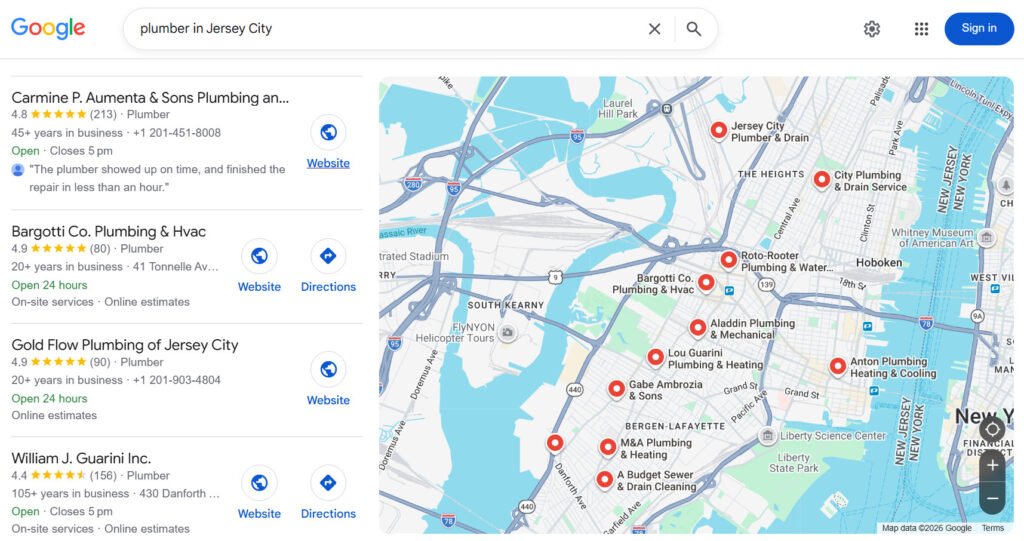
When someone searches for “plumber in Jersey City”, Google tries to identify businesses that are relevant to the search and can reasonably serve customers in that area. Some results appear in the regular organic listings. Others appear in the local pack, the group of business listings displayed alongside a map.
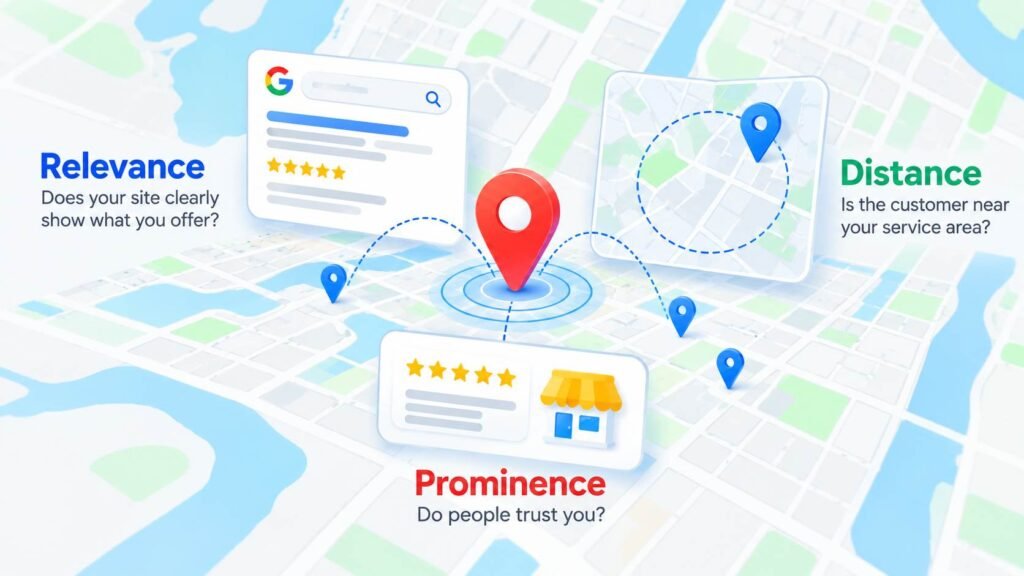
According to Google’s local ranking guidance, three broad factors influence local visibility:
- Relevance – How closely a business matches what someone is searching for
- Distance – How far the business is from the location associated with the search
- Prominence – How established and well-known the business appears to be, including signals such as reviews and links
A business cannot control where every potential customer searches from. But it can improve how accurately its services are represented and build a stronger local reputation.
Target the Services Customers Actually Search For
Business owners often describe their services differently from customers.
A contractor might advertise “comprehensive residential restoration solutions”. Someone with water leaking through their ceiling is more likely to search for “ceiling water damage repair”. That difference affects which keywords deserve attention.
Consider an air-conditioning company. Someone searching for “AC repair near me” probably needs a technician soon. Another person searching for “air conditioner installation cost” may still be comparing options. Both searches are relevant, but the intent is different. Tools such as Google Keyword Planner can help identify related searches and estimate demand. The priority should be keywords that reflect both the services a business offers and what potential customers are actually searching for in the areas it serves.
Search Volume Isn’t Everything
A broad keyword attracting thousands of searches might deliver fewer enquiries than a specific local phrase. Take “bathroom design ideas” versus “bathroom renovation contractor in Dallas”. The first attracts people looking for inspiration. The second is much closer to a hiring decision.
For a service business, a handful of qualified local visitors can be more valuable than hundreds of people who will never become customers.
Get Your Google Business Profile Right
For many service businesses, the Google Business Profile is the first thing a potential customer encounters. They might check reviews, look at photographs or call directly from the listing without ever visiting the website.
Start with the basics. Choose the most accurate primary business category, add relevant secondary categories and keep contact details, opening hours and services current. Photographs deserve attention too. A roofing company showing completed projects gives potential customers something more useful than a collection of generic promotional graphics.
Be Accurate About Service Areas
Businesses that travel to customers can specify the areas they serve. A mobile appliance-repair company, for example, might cover several neighbouring towns from one operational base.
But adding more locations does not automatically improve rankings across those places. Google’s service-area business guidelines explain how these profiles should be configured. The listed areas should reflect where the business genuinely operates.
Why Local Rankings Change Across the Same City
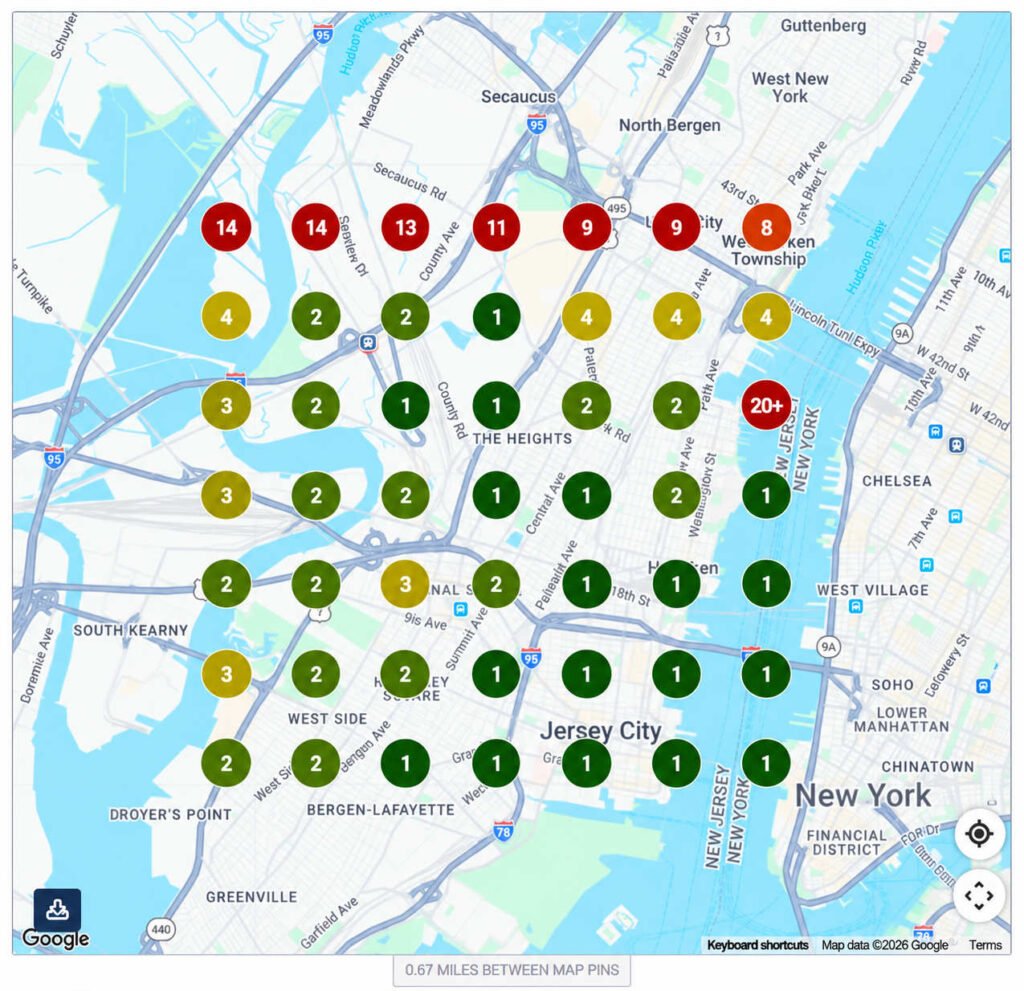
Continuing with our earlier plumbing example, a plumber might rank first in Google Maps for “plumber in New Jersey” when searching from one location, but appear considerably lower in the results just a few miles away. Nothing about the business or its website has necessarily changed. The searcher’s location has.
This is why checking rankings from one location gives an incomplete picture.
Local rank-tracking tools can measure visibility from different points across a city or service area. Results are often displayed as a grid, showing how a business ranks for the same search across different locations. Some tools that provide this functionality include:
- Local Falcon – Generates GeoGrid reports showing Google Maps rankings across different locations
- BrightLocal – Offers Local Search Grid reports to track local rankings and compare visibility across an area
These maps help businesses identify neighbourhoods where they rank well and areas where competitors have stronger visibility. Comparing results across different locations can reveal patterns that a single ranking check would miss. Businesses can then examine factors such as competitor proximity, customer reviews and the relevance of their service pages to identify opportunities for improvement.
Build Service Pages That Answer Real Questions
A common website problem is putting every service on one page. An electrical contractor might offer wiring, panel upgrades, fault diagnosis and EV charger installation. But if the website only has a general “Our Services” page, Google has limited information about each offering.
Dedicated pages give businesses room to explain their work properly. An EV charger installation page, for example, could cover charger compatibility, electrical requirements, installation costs and the inspection process.
Such details help customers decide whether the company is suitable while giving search engines clearer context.
Avoid Repetitive Location Pages
A business serving multiple towns may benefit from individual location pages, particularly where it has genuine local experience or projects to showcase. But creating twenty nearly identical pages and changing only the town name is unlikely to help.
Google’s spam policies address doorway abuse, including pages created primarily to capture similar searches and funnel visitors to the same destination.
Location pages should contain information genuinely useful to customers in those areas.
Customer Reviews Can Influence Who Gets the Call
Reviews help potential customers judge a business while contributing to its local search prominence. Imagine two appliance-repair companies appearing next to each other in Google Maps. One has 12 reviews averaging 4.9 stars. The other has 140 reviews averaging 4.7.
The first has a slightly higher rating, but the second offers considerably more customer feedback. That larger history may give potential customers greater confidence.
For service providers, a good time to request a review is shortly after completing a job. A cleaning company could send a follow-up message later that day. A renovation contractor might ask during the final handover.
Google’s review guidelines allow businesses to request genuine feedback but prohibit incentives in exchange for reviews.
And don’t ignore negative feedback. A calm, specific response can tell future customers quite a lot about how a company handles problems.
Look at the Competitors Actually Beating You
Your most important local competitor is not necessarily the largest company in your industry. It is the business appearing above yours for searches that matter.
Suppose a landscaping company repeatedly loses visibility for “garden maintenance” to another provider nearby. Comparing their websites and Google Business Profiles might reveal differences in business categories, service-page content, customer reviews or local backlinks.
Distance may also be a factor, particularly when the competitor operates closer to the searcher.
Choose a few competitors that consistently outrank you and examine what they are doing differently. The goal is not to copy their websites, but to identify useful improvements you may have overlooked.
Local Links and Business Mentions Matter
Backlinks are often discussed in terms of domain authority, but local relevance deserves attention too.
A roofing company featured by a regional builders’ association may earn a useful mention and a relevant link. A local newspaper covering a community restoration project might provide another opportunity.
Some practical sources include:
- Industry associations – Relevant trade organizations that publish member directories or profiles
- Local partnerships – Suppliers, complementary businesses or community initiatives where a genuine editorial mention makes sense
- Regional publications – Local journalists covering noteworthy projects, business developments or community contributions
- Established directories – Reputable business directories that potential customers actually use
These mentions can help build visibility, but their value is not limited to rankings. Some may bring customers directly.
Measure Enquiries, Not Just Rankings
A service business can improve its local rankings without seeing much improvement in actual enquiries. That may happen because it is attracting visitors outside its service area, ranking for the wrong keywords or making it difficult for people to get in touch.
Google Search Console can show which searches generate impressions and clicks. Google Business Profile performance reporting provides information about listing interactions, while Google Analytics can help track website activity and configured conversions.
But the most useful information may come from the business itself. How many qualified calls were received? Which services generated enquiries? How many quotations became paying jobs? A contractor receiving eight serious enquiries for kitchen renovations may be doing better than one receiving fifty unrelated enquiries for minor repairs.
Local SEO performance should ultimately be judged by the business opportunities it creates, not just ranking improvements.
Where Should a Service Business Start?
Trying to improve everything simultaneously rarely works well, particularly when the owner is also managing customers, staff and daily operations.
Start with the Google Business Profile. Check the categories, listed services, business hours and service areas. Correct anything inaccurate.
Next, examine the website pages for the services that generate the most revenue. If a company specializes in commercial electrical installations but barely mentions them on its website, that deserves attention before another general blog post is published.
Review how the business appears in local searches, compare a few competitors and make customer reviews part of the normal follow-up process.
Then measure what changes.