

ChatGPT ads are attracting more clicks as OpenAI expands its advertising business, but early performance data suggests those clicks aren’t being distributed evenly across markets.
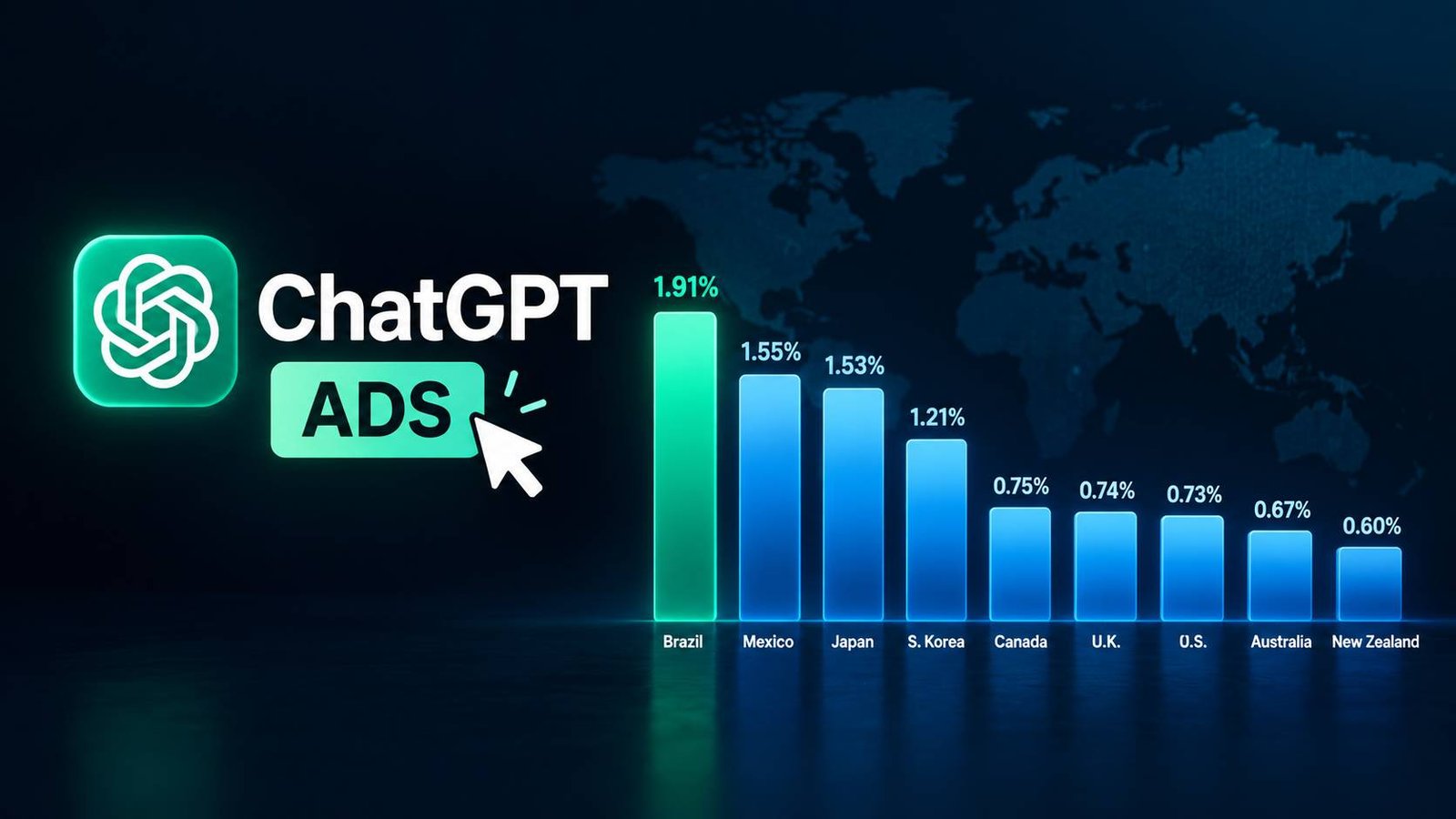
New research from Graphite and Similarweb found click-through rates above 1% in Brazil, Mexico, Japan and South Korea. The U.S., U.K., Canada, Australia and New Zealand were all below that mark.
The spread is fairly wide. Brazil recorded the highest CTR in the dataset at 1.91%, while New Zealand was at 0.60%.
And these numbers arrive while ChatGPT advertising itself is still changing quickly.
ChatGPT Ad CTR Varies Considerably by Country
Graphite’s The State of ChatGPT Ads research examined ChatGPT ad activity using Similarweb’s panel data, with CTR measured from each market’s first appearance in the dataset through September 16.
Here’s how the nine markets compared:
- Brazil: 1.91%
- Mexico: 1.55%
- Japan: 1.53%
- South Korea: 1.21%
- Canada: 0.75%
- U.K.: 0.74%
- U.S.: 0.73%
- Australia: 0.67%
- New Zealand: 0.60%
Source: Data compiled from research published by Graphite
The gap is noticeable. All four markets above 1% are outside the group of English-speaking countries covered by the research, while those five markets sit within a relatively narrow range of 0.60% to 0.75%.
Different user behaviour, advertiser mixes and the relative maturity of ChatGPT ads in each country could all play a role, but the research doesn’t establish a cause. The markets also weren’t measured over identical periods; each has between five and 25 weeks of data.
These Aren’t Conventional Campaign CTR Benchmarks
There is an important wrinkle in how the numbers were calculated.
The report defines CTR as clicks divided by ad-bearing exchanges, with an exchange consisting of a user message followed by ChatGPT’s response. Results are pooled across advertisers within each market rather than representing the performance of a particular campaign.
Similarweb provides percentages and shares rather than the underlying counts, so the report doesn’t disclose exactly how many users or ad-bearing responses sit behind each country’s CTR.
OpenAI’s guidance on ads in ChatGPT explains that advertisers can track metrics including impressions, clicks, CTR, CPC, CPM and conversions through Ads Manager. But these early market-level figures aren’t the same thing as campaign benchmarks.
So, a U.S. advertiser seeing a 0.73% CTR shouldn’t automatically treat that figure as a target, nor should 1.91% become the benchmark for campaigns in Brazil.
The Biggest Advertisers Keep Changing
The research also gives a glimpse of who is buying ChatGPT ads, and the leaderboard isn’t particularly settled.
Only Jotform and Resume.io remained among the ten largest advertisers worldwide by impression share across all 20 weeks measured from May 4 to September 14. Cursor and Monday.com appeared in the top ten during 15 of those weeks, while Booking.com made it during 10.
Graphite describes advertisers as being in “experimentation mode”. That fits the movement in the data. Some major advertisers built up impressions before pulling back, while others moved into the top group for shorter periods.
B2B SaaS has been particularly prominent, accounting for 19.9% of U.S. ChatGPT ad impressions in the report’s category analysis. Retail and consumer brands followed at 10.4%.
ChatGPT’s Advertising Business Is Scaling Quickly
The performance data lands at a time when the advertiser base has been expanding fast.
In June, Similarweb reported that it had tracked 5,171 unique ChatGPT advertisers since March 30. Active advertisers increased from 2,585 to 3,770 in the seven days ending June 8, a 46% jump after the minimum spend threshold was lowered.
OpenAI has continued developing the advertising platform since then. Advertisers can now run campaigns around different objectives while monitoring performance through Ads Manager.
The formats are changing as well. OpenAI recently introduced Sponsored Agents, a format that allows someone who clicks an ad to start a conversation with a business-sponsored agent inside ChatGPT rather than simply being sent to a conventional landing page.
That’s quite different from the familiar search ad model, where the click usually marks the point at which the user leaves the platform.
Early Data, but a Clear Geographic Split
ChatGPT Ads is still a young advertising platform, which makes sweeping conclusions from a few months of data risky. The different measurement windows between countries add another reason for caution. But the geographic variation is difficult to miss.
A click-through rate of 1.91% in Brazil versus 0.73% in the U.S. is a substantial gap, even if neither number should be treated as a universal campaign benchmark.
As more advertisers enter ChatGPT and more markets accumulate longer performance histories, those differences may narrow or become more pronounced. For now, the latest data shows that user response to ChatGPT ads can look quite different depending on the market.